In everyday life and at work, it helps to tackle large projects in small steps. This is also how microlearning works: Small, bite-sized learning chunks create real learning transfer! Take a look at examples of microlearning now – as an alternative to complex instructions in everyday life and as an online companion for training courses.
The Ultimate Microlearning Guide for Online Courses
Get started with your own microlearning course now! In our new guide, you will learn step-by-step how to build your own microlearning. With lots of tips and examples.
The Idea Behind Microlearning: Short Learning Bites
Microlearning, micro-learning, or bite-sized learning – all these technical terms point to one idea: To simplify the learning process by breaking it down into small bites. This works just as well in corporate training as it does in everyday life, for example, when you want to operate a device for the first time.
Update August 2022: Are you interested in the topic of bite-sized learning? Then read the article about Learning Nuggets (definition + examples) on our blog now! 💡

The idea of microlearning: breaking learning content down into small chunks to make it easier to process.
If you want to offer content in the form of microlearning, ideally you start directly with small chunks. How that works, I described here some time ago: Microlearning – 3 rules for creating learning bites.
Today, I'm presenting concrete examples of microlearning to you. What short learning content can look like in everyday life and at work:
In everyday life: As an alternative to unloved manuals
At work: As an online course for corporate training
1st Example: Microlearning in Instructions
When was the last time you read a manual? Like – actually read it? It's probably been quite a while – at least according to a study that examined our behavior towards instruction manuals. "Life is too short to RTFM" is the title of the study: Life is too short to read the manual.
The findings of the scientific study are not surprising to us, but they give us nice statistics on the topic of learning:
People read only about 25% of instruction manuals for everyday devices.
The more educated, the less people read manuals.
The younger, the less people read manuals.
The reason: Manuals are often too complex and we associate negative emotions with them: Takes too long – Doesn't help anyway – Doing it yourself is faster! The trend is towards "learning by doing" – especially among educated and young people.
In order not to leave customers completely on their own, more and more companies are turning to the concept of microlearning. For this purpose, not only is the detailed manual included to look up a specific problem, but also a very brief, usually illustrated quick-start guide for the first steps.
Microlearning in everyday life therefore works best as a quick-start guide: As few steps as possible, presented as simply as possible!
Microlearning Example: Manual for the rocket pack – Card game for Blended Learning
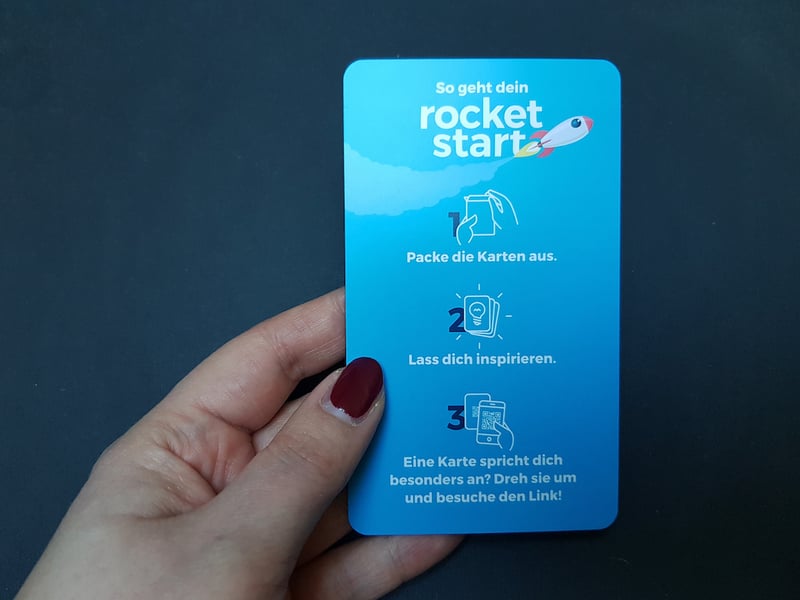
The rocket pack is a card game for educators looking for inspiration for their blended learning. In addition to an instruction booklet with detailed descriptions, a card is also included that allows the user to start directly – following the microlearning principle:
Three small steps
Little text, simply phrased
Clearly illustrated
Highly action-oriented
2nd Example: Microlearning in Training
Our behavior with manuals shows how important learning in small bites is in all forms of learning. However, the content is not always as easy to understand as in the rocket pack card game. For long-term behavior changes in corporate learning, a training participant often has to process a lot of complex content.
Trainers therefore often find it difficult to summarize their knowledge, gathered over years, in two minutes. And don't worry: Microlearning is not about cutting out so much that only an empty buzzword is left! On the contrary: Content for microlearning is not only short, but also highly action-oriented.
Just like in this example by trainer Wolfgang Schneiderheinze, who addresses the topic of "filler words" in his online companion in the form of microlearning: In just over a minute, a problem, a solution, and a practice task are packed for the participants – very short, and yet with a lot of content:
This is What Microlearning Looks Like as an Online Companion
The video shown above is micro-content and part of a complete online course. The idea: To offer many short learning impulses following a classic classroom training.
This allows the training participant to process small pieces of content bit by bit – ideally spread over several weeks to enhance learning transfer.
Integrated into a complete online course, microlearning looks like this, for example:
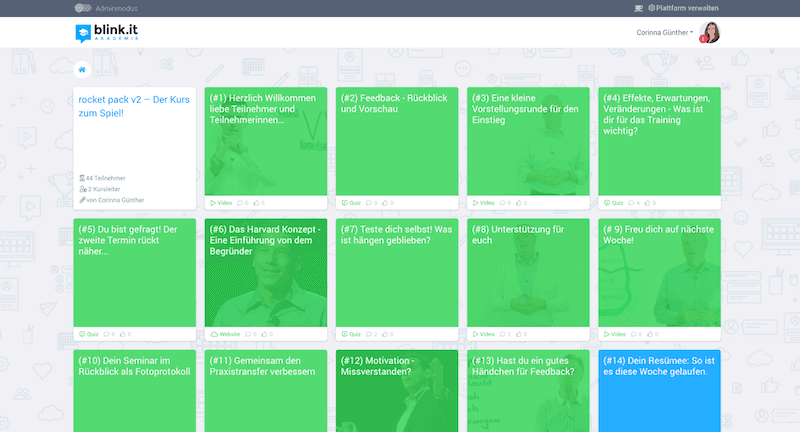
Example of microlearning with the blink.it learning platform: The user has already viewed the green micro-content; the blue ones are unlocked but not yet viewed.
How Microlearning Works in the Online Course for the Participant
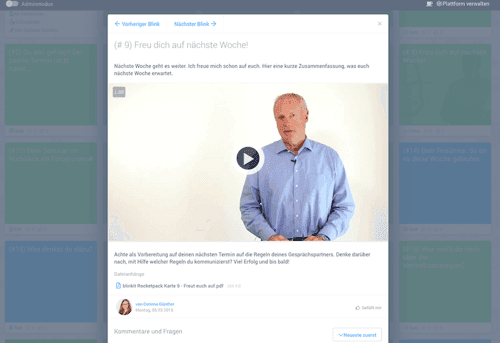
Basically, each tile ("Blink") is a piece of micro-content, i.e., a small learning unit. This can be a video, a short text, or even a quiz. It is important that each Blink in microlearning is linked to a concrete call to action and is really quick to complete.
The participant starts with the first Blink and gradually works their way through the entire course – always at their own pace, embedded in their own daily routine.
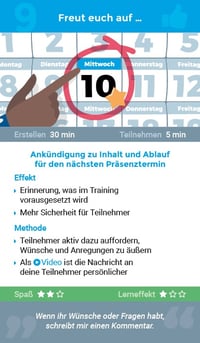
How you can use these methods is shown in the following examples of microlearning. This is what the methods "Look forward to", "The virtual discussion" and "Tickle the detective in you" look like when implemented in an online course:
1st Microlearning Example "Look forward to..." (Category: Support)
2nd Microlearning Example "The Virtual Discussion" (Category: Reflect)


3rd Microlearning Example "Tickle the Detective in You" (Category: Understand)
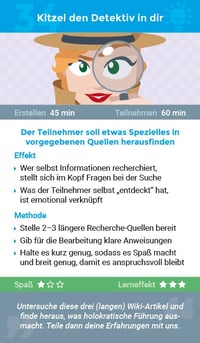

The result in all examples: Short learning bites with compact content that are perfect for microlearning!
Conclusion
Microlearning unfolds its greatest impact when learning content is consistently divided into action-oriented, clearly defined units that can be flexibly integrated into daily life and work.
Whether in the form of a quick-start guide or as a companion online unit as part of training: Small learning bites lower the barrier to entry, increase motivation, and support sustainable learning transfer. The key here is not just the brevity of the content, but its clear structure and immediate applicability.
Used correctly, microlearning becomes a powerful tool to make complex topics tangible and to anchor learning permanently in everyday work.

Frequently Asked Questions and Answers
What is the difference between microlearning and traditional training?
Microlearning delivers content in small, clearly defined learning units. This makes it easier to integrate knowledge and practice into everyday work than with long, continuous training courses.
For which topics is microlearning particularly suitable?
Microlearning is primarily suitable for concrete step-by-step instructions, individual skills, reviews, and accompanying learning impulses within the scope of larger professional development measures.
Why does microlearning improve learning transfer?
Short, action-oriented learning impulses can be applied immediately. By spreading them over a longer period of time, what has been learned is better retained and more easily integrated into daily work routines.
Can microlearning also convey complex topics?
Yes. Complex topics are not simplified, but rather structured into logically building learning bites. This creates complete understanding step-by-step.