Distance learning is possible – the Covid-19 pandemic has clearly shown us that. At the same time, digital learning formats have other advantages than just minimizing the risk of infection with a virus. Find out now what is behind distance learning and how this learning method moves your employees forward!
Whether it's languages, lifestyle topics, or in-house further education – you can find online learning opportunities on a wide variety of topics. Because the digital framework in particular makes it possible for employees to be much more flexible and thus participate in training courses, despite working from home. But how does learning at a distance work in the first place?
Distance Learning means learning at a distance
The term "Distance Learning" translates to learning at a distance and implies that learners no longer have to be physically present in a specific location to participate in training. Instead, the learning process is mapped via online media. With formats such as webinars or online courses, you convey your content and motivate learners to achieve their learning goals! This allows learners to work on their learning goals regardless of time and place. But distance learning offers you even more advantages:
These are the opportunities that distance learning offers you
Participating in training digitally benefits not only learners but also instructors. This gives learners a high degree of flexibility, as long travel distances are eliminated and their own time management can be adjusted spontaneously. As an instructor, you can monitor the learning goals of your participants much better, e.g. through statistics functions in the online course! Distance learning offers you the following advantages:
Diversity: Through online training, you have the opportunity to address a much larger target group because your participants are not tied to a single location. This allows you to offer a wide range of topics – even for employees who do not work at your location!
Own pace: If you set up your content in online courses, for example, your course participants can divide their time flexibly and work through the chapters of your course at their own learning pace.
Work-Life Balance: Private life requires a high degree of flexibility, because every now and then unforeseen appointments disrupt your schedule. This allows you to combine work and private life in a better way.
Cost savings: In-person training can often be very expensive. In addition, only those employees who were present on the day benefit. Therefore, create online courses and ensure that future employees also quickly reach the same level as their colleagues.
Adaptation of learning preferences: Do your employees have different focuses and therefore need different training? No problem! With the blink.it learning platform, you can duplicate and adapt online courses that have already been created. This way, you don't have to plan a new training course for other focuses, saving you time in creating your new course.
As you have seen above, online training formats have several advantages! However, there are certain aspects that you can implement better in face-to-face events. We will present these aspects to you and show you at the same time how you can solve these problems!
Disadvantage | Description | Our Solution |
Dry training | Imagine sitting in front of your computer at home and having to follow an online seminar on data protection with excitement. Do you already have zero motivation just thinking about it? No wonder – due to the lack of contact with colleagues, a dry topic can become even more boring! | As a course creator, you can use gamification to wrap dry topics into a story and thus make your training popular among course participants! |
Who is available for questions? | Questions often arise during training courses, because after all, the goal is to learn new topics and achieve learning objectives. But how can your course participants contact you so that you can react quickly and easily? | On the blink.it learning platform, your course participants have the opportunity to ask you questions via chat or to write in the comments. This way, the other participants can see your answer too! |
Lack of exchange with each other | Personal contact with colleagues contributes to the exchange of knowledge among each other. This is how your course participants learn new standpoints and perspectives. But how is that possible with distance learning? | Interaction with colleagues is promoted in shared chapters. Every course participant has access to these and can comment on personal experiences. |
In addition, you have the option of supplementing your online training with blended learning formats. Find out now which formats are didactically smart!
Distance Learning becomes Blended Learning
Frontal teaching and learning by rote are things of the past – we will now show you the three most popular models for combining online training and face-to-face events!
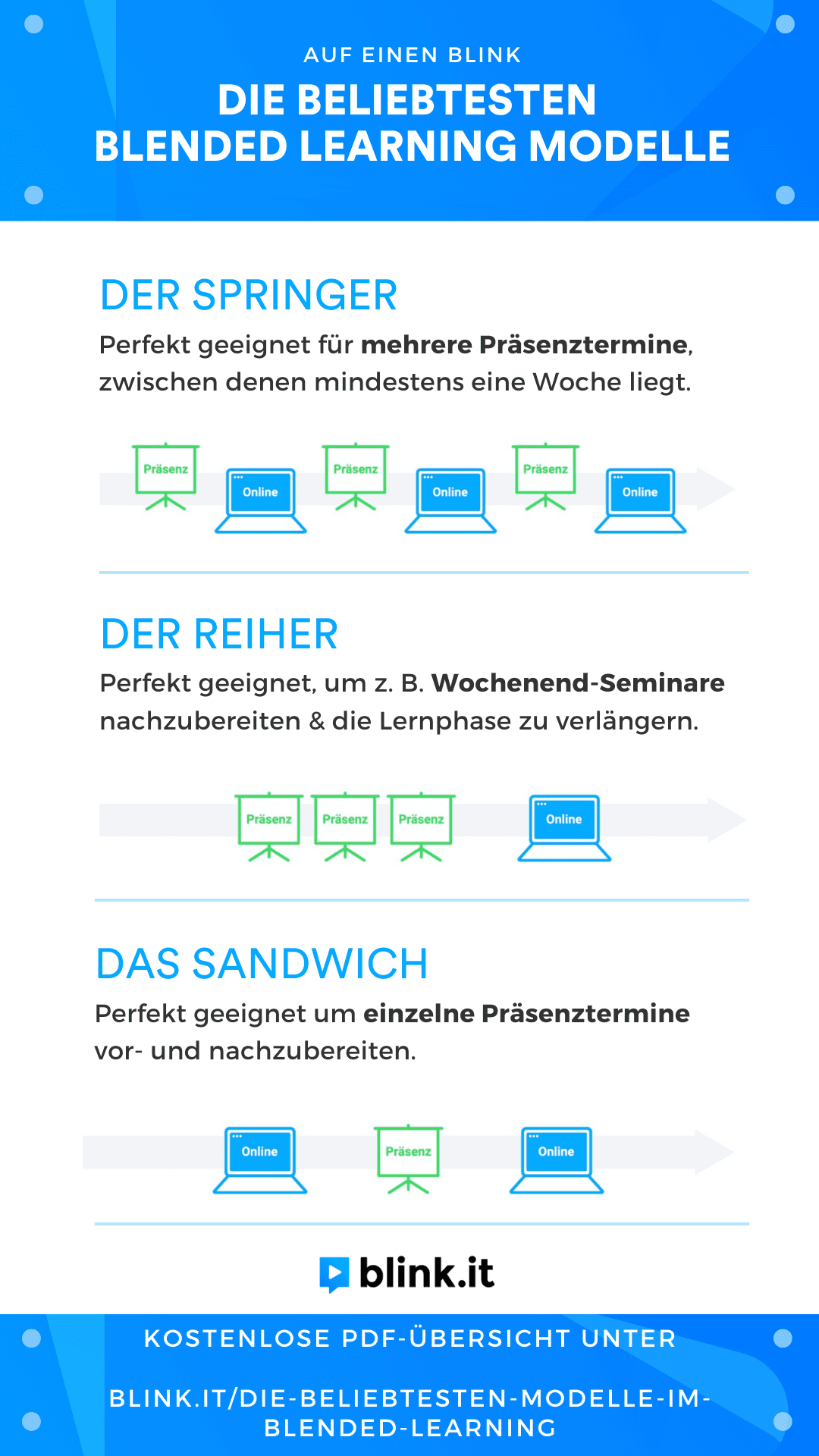
Do you want to achieve the optimal learning result? Then you should interlock face-to-face events and self-directed online learning phases. Depending on the model, you can align your training according to the needs of the participants or the framework conditions in the company. This way, you combine the advantages of both online and offline training and offer your course participants a didactically meaningful learning experience!
By the way, we have already written more about learning at a distance. Find out more now: Online, but personal! How to succeed in training at a distance
High flexibility through online training offers – sounds good? Yet, you still want to maintain personal contact with your course participants? Then combine the best of both worlds and choose one of the presented blended learning models! This way, your company benefits from training courses that are adapted to the needs and framework conditions of your employees!