Are you looking for training software for your company? Then Sales Manager Hans-Martin Sprungk has some tips for you: Which framework conditions should you clarify and what matters in a conversation with a tool provider? You can find the most important points clearly arranged in a checklist for download!
Checklist for HR Managers: Finding the Right Training Software
Perhaps you are like many companies in recent years: you want to use training software to improve internal further education. Typically, HR developers solve challenges with the introduction of an LMS such as:
Sustainability: Long-term learning success even beyond the seminar
Centralization: Training for decentralized locations
Transparency: Quick overview of learning progress
But what should you look out for when searching for online training software? We asked Hans-Martin Sprungk: The blink.it Sales Manager has already spoken with hundreds of HR developers and trainers and knows common processes and requirements.
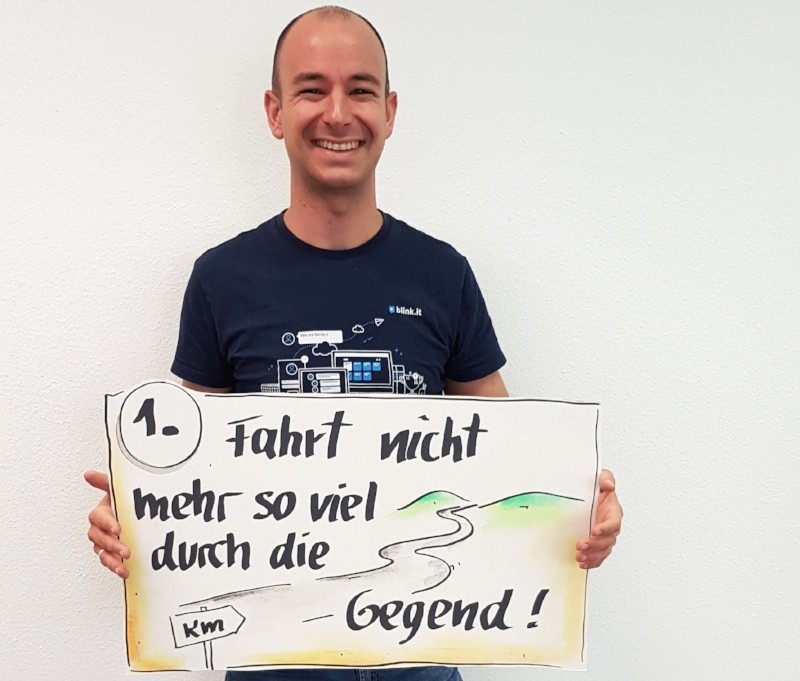
Interview: What Should HR Managers Look For When Searching for Training Software?
Part 1: Preparing Your Search
Hans-Martin, you talk to HR developers almost daily. What are typical questions that I should clarify internally when looking for training software?
That depends heavily on the size of the company. Large companies have stricter restrictions, for example regarding data protection or the works council. In SMEs, there are usually shorter decision-making paths and more flexibility. Basically, you should speak with all important departments: What are must-haves for the software – and what are absolute no-gos? My tip: Clarify before your search whether XY is a hard criterion or if you have some room to maneuver.
And as far as the use case is concerned: What should HR developers keep in mind when looking for training software?
Typically, an online training tool is supposed to solve one problem in particular: to make the content more sustainable. Therefore, it is of course important that the software is also easy to use. The greatest blended concepts are useless to you if the employees cannot cope with the tool.
Another use case that is becoming increasingly important: with an online tool, you can decentralize training. In-person training becomes difficult and, above all, expensive when a company has locations distributed throughout Germany or even internationally. For such a case, it is particularly important that the software solution is flexibly accessible. This means that you can use it just as well on a mobile phone as on a tablet or computer.
Part 2: The Selection of Software Providers
Now that I have clarified all internal requirements – how do I find software providers that fit our company and use case?
That is not so easy to answer. There are now very many providers and they all have different focuses. In addition to the hard criteria from the pre-selection, I would look closely at:
Does the training software fit our corporate philosophy?
How easy is the software to use? Both from a user and an admin perspective!
What else is offered to me besides the product? How is the support and do I also receive assistance with the implementation of the content?
Part 3: Conversations with the Software Provider
The time has come – Imagine you are speaking with an HR developer about whether blink.it is the suitable training software. How does an ideal conversation go?
An ideal conversation is when both sides are satisfied. I don't want to sell anyone something that doesn't fit! That is why it is very helpful if my conversation partner is well prepared. Though there are three types of conversations: from completely unprepared to a huge catalog of requirements, which is then often unrealistic. The middle is ideal: if you have a rough outline before the conversation, but at the same time are open to the tool.
In the initial conversation, openness is incredibly important, because, just like on a first date, it's about chemistry. There might be workarounds for individual points of criticism later on. Of course, the training software should not be one single workaround, but an 80-90% match between software and company is realistic.
Are there points that HR developers frequently forget when searching for training software?
Many HR developers are very well prepared regarding the technical and logistical requirements of the tool. What is frequently forgotten is the content side, the content creation. Many invest a lot of time and energy in selecting the platform. But in the end, the tool is just that – a tool. Therefore, my final tip would be:
Plan the content for the online training software right from the start! The platform itself only accounts for about 20% – both of the learning success and the time required for preparation.
Conclusion
The right training software for companies combines easy usability with the functions and framework conditions that are actually needed for the specific training application.
Before starting their search, companies should therefore clarify their most important requirements, exclusion criteria, and use cases. It is worth involving not only IT, data protection, and HR development, but also considering the perspective of the future users.
Just as important is looking beyond the software: A learning platform creates the technical requirements for digital training, but good learning content and a well-thought-out learning concept do not arise automatically. Content creation should therefore be part of the planning right from the start.

Frequently Asked Questions and Answers
What should companies look for when choosing training software?
Important are the concrete learning goals and areas of application as well as framework conditions such as data protection, technical requirements, and internal guidelines. User-friendliness, support, and options for content creation should also be taken into account.
Who should be involved in the selection of training software?
In addition to HR development, depending on the company, IT, data protection, the works council, and the future users should be involved, for example. This allows important must-haves and exclusion criteria to be defined at an early stage.
How important is user-friendliness in training software?
User-friendliness is crucial for both employees and administrators. A software can meet many professional requirements, but loses its usefulness if it is too complicated to use in daily work.
Why should content creation be considered already during software selection?
The software merely provides the technical framework for digital training. Companies should therefore clarify at an early stage how learning content is to be created, maintained, and integrated into the training concept.