How can trainers and coaches make their e-learning even more successful with gamification? Alexandra Nagy from Kunde 21 climbed a virtual mountain together with the participants in her online course on Customer Experience. In this article, you will learn how she playfully guided her course participants to success with "Reach The Top".
Many people imagine different things under the term gamification: many think directly of Virtual Reality and the like. However, gamification actually only means one thing – increasing the motivation and thus the learning progress of the course participants through the fun factor. No high-tech devices are needed for this! Even simple playful elements make your course more exciting and interactive. This way, your gamification course appeals to a wide customer segment and motivates the participants to successfully complete the online course!
Customer Orientation in the 21st Century
The company Kunde 21 advises businesses in Austria – as the name suggests, with a strong focus on customer orientation. Since 2019, Kunde 21 has been working with blink.it to offer its clients maximum learning transfer. The term Customer Experience (CX) describes the path that companies take to align themselves with the needs of the customer in the 21st century.
Managing Director Alexandra Nagy told us more about the Customer Experience (CX) Challenge in an interview. This took place over the entire last year and followed the motto "Scaling the CX Mountain Together". Alexandra Nagy combined storytelling and gamification in her blink.it course. In this way, she virtually "hiked" up the mountain together with her course participants.

About the Person: Alexandra Nagy is Managing Partner of Kunde 21 GmbH and Managing Director of the Communications Hub Austria. She has been active in the management industry for over twenty years and has already helped build various international brands and companies. In her work, she has specialized in Customer Experience and Customer Centricity.
Playfully Climbing the Mountain of Customer Experience
The CX Challenge by Kunde 21 consisted of the following components:
Over the entire last year, a new learning unit (a Blink) on the topic of Customer Experience was published in the online course every month. The Blinks marked twelve stations on the way to the goal. To reach the goal – the mountain peak – the participants had to complete the twelve Blinks. In addition, a prize was raffled off every month to repeatedly boost the motivation of the participants. This prize matched the entire challenge and included, for example, a package with granola bars and nuts.
This is how Alexandra Nagy introduces the project in the video:
Alexandra Nagy introduces the Customer Experience Challenge from Kunde 21
"We put everything under one motto and carried it through the entire challenge." – Alexandra Nagy
In order to participate in the raffle for the prize, the course participants had to complete a survey at the end of each of the twelve Blinks. The idea behind this: after completing each survey, the participants reached the stage goal and got a step closer to the mountain peak.
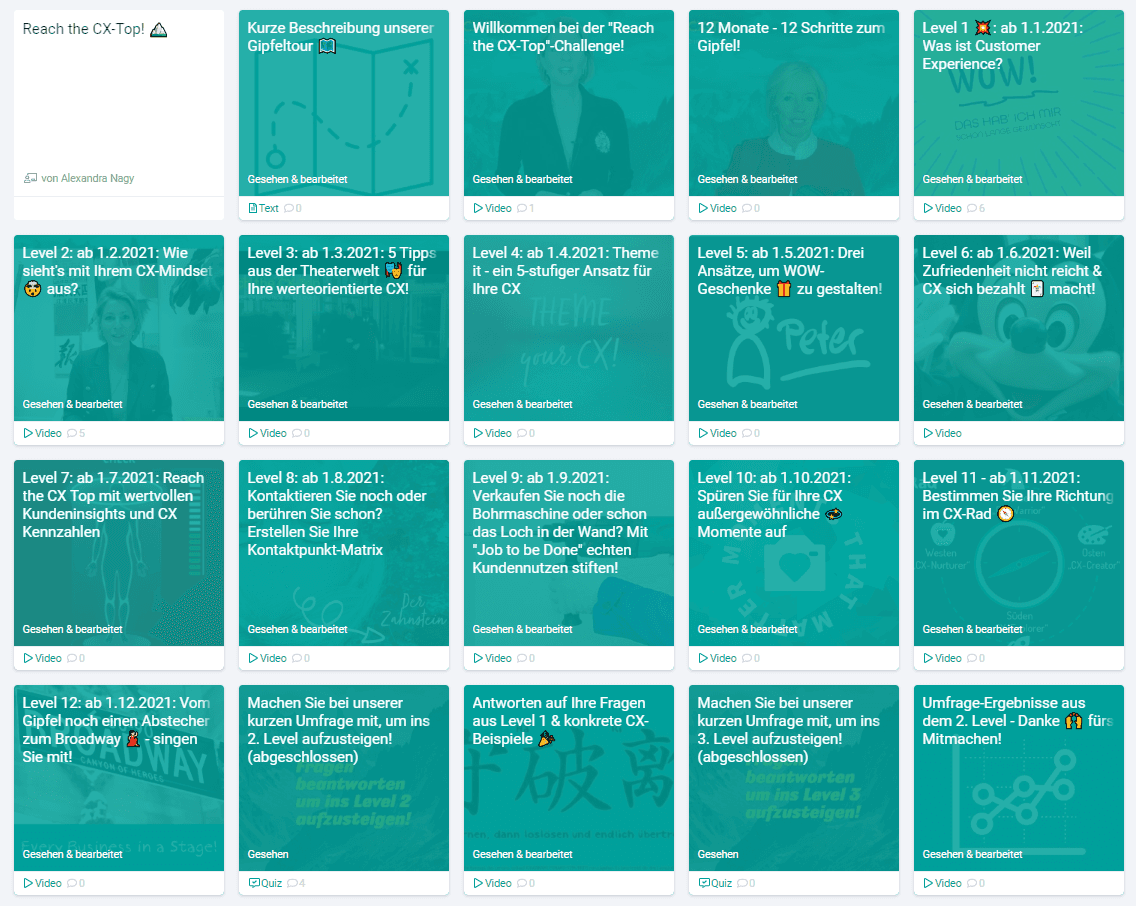
Chapter overview of the Customer Experience Challenge on the blink.it platform
Through the CX Challenge, course participants not only learned something, but also grew beyond themselves level by level. In addition, gamification elements ensured that the participants developed the ambition to pull through the challenge to the end.
What these gamification elements looked like is presented by Managing Director Alexandra Nagy in the following interview:
Interview with Alexandra Nagy: Gamification using the example of the "CX Challenge"
We asked Alexandra Nagy the following four questions in the interview:
Question 1: For which topics is gamification suitable?
Question 2: What should be considered when implementing gamification?
Question 3: How can gamification be implemented with blink.it?
Question 4: What advantages does blink.it offer especially for gamification courses?
Question 1: For which topics is gamification suitable?
Whether dry or interesting – gamification is suitable for all topics! Especially for content where learning is perceived as tedious. Because playful elements loosen up such topics. This promotes the motivation of the course participants, as learning successes become visible through, for example, levels or points collection. This way, you reduce the likelihood of participants dropping out of the online course prematurely. Through gamification, you as a trainer have the opportunity to create courses that contain challenges and tasks. This way, your course participants develop further and grow step by step beyond themselves!
Question 2: What should be considered when implementing gamification?
Alexandra Nagy has the following four tips on how to sensibly integrate gamification into your online courses:
1. Knowledge level of your course participants
Where is the skill level of your participants? With the help of a quiz or a survey, you can find out how much background knowledge is already present. This way you find the perfect balance between challenge and learning success!
Info: The Flow Theory is based on the premise that learners must not be over- or under-challenged in the learning process. When both are balanced, learners go beyond personal goals and increase their learning and development curve.
Gamification gives participants the opportunity to keep developing their skills. In doing so, they don't just learn in a dry way, but master challenges and tasks so they can develop their skills step by step.
Alexandra Nagy
2. Tell a story
Think of an exciting story and build your course around it! If you choose a theme and align your course content with it, it immediately becomes more interesting. The story gives your online course consistency and a framework. Your course goal is thus clearly recognizable and your participants know what is needed to climb the mountain peak. A unique story also generates attention:
By giving them a story to tell, the participants also wonderfully spread the word about the challenge.
Alexandra Nagy
3. Transparent goals
Clearly formulated goals show your course participants what they will achieve with your online course. Gamification elements (level thinking, collecting points) support the motivation and ambition to develop further and reach the goal.
It is also important that gamification does not become an end in itself. Points, levels, or prizes only develop their effect when they are clearly linked to concrete learning goals. Every playful stage should therefore visibly contribute to building skills and not just generate short-term activity.
4. Sustained motivation
Levels, as in the CX Challenge, show the current learning progress and how the participants are getting closer and closer to the course goal. This progress acts like a "positive trigger" for many. Additional prizes also spark motivation and determination in participants to complete the course. Sustained motivation is therefore the key to growing beyond oneself and reaching the summit of the mountain.
Question 3: How can gamification be implemented with blink.it?
The CX Challenge consisted of a kind of "best-of" content around the topic of Customer Experience from Kunde 21. This content still had to be adapted to the mountain peak story and level thinking. Accordingly, the course content was loosened up with images and videos matching the theme.
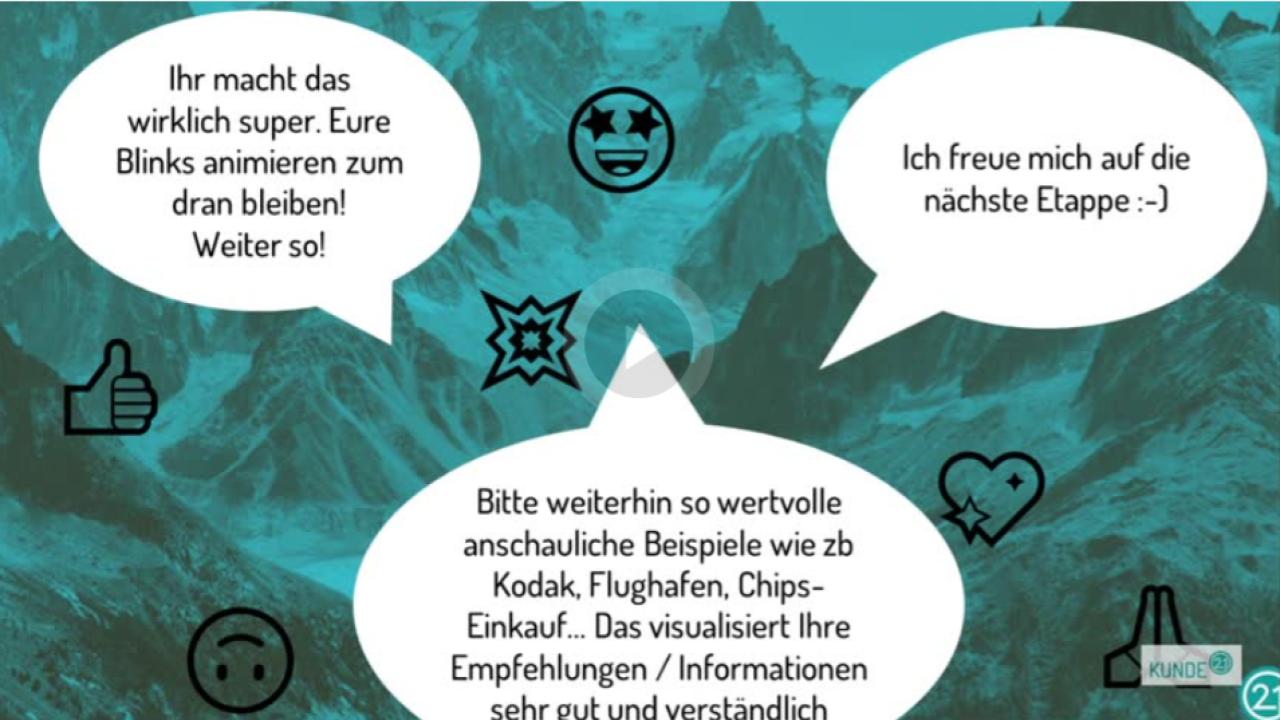
Participant feedback from the CX Challenge
Gamification is often criticized because the playful elements allegedly cause the knowledge content to fade into the background. But that doesn't have to be the case! Therefore, it is important to maintain the balance between playful elements and learning content.
Everything you tell – no matter how funny it is – must be connected to theory.
Alexandra Nagy
Question 4: What advantages does blink.it offer especially for gamification courses?
1. Different media
To make gamification courses particularly immersive, the knowledge content should be loosened up and adapted to a specific theme. You want to tell a story! Therefore, use different formats in the course. This allows your participants to immerse themselves better in the story. You visually support your theme with, for example, cover images of your courses and chapters, images, videos and audio files in your courses, and by linking to other websites (e.g. YouTube).
2. Intuitive and easy operation
The blink.it learning platform is intuitive to use not only for course creators but also for course participants. This allows participants to easily immerse themselves in the story of the gamification course and are not put off by a complicated application.
For us, support for the participants with blink.it is virtually zero. There are never any problems.
Alexandra Nagy
3. Reflection at the end of the Blink
Despite gamification, the learning effect and personal development must not fade into the background. That's why the participants of the challenge answered a survey at the end of each Blink. This helped to reflect on and apply the knowledge learned. At blink.it, you can choose between a quiz, survey, and exam and integrate them into the appropriate place in the chapter. This makes the gamification course even more interactive and ensures that knowledge content is not neglected!
Our requirement is that we can convey all our content and upload it easily. The blink.it platform is intuitive from our side (as creators) and for the participants as well.
Alexandra Nagy
Conclusion
Successful e-learning happens where motivation, structure, and learning goals are strategically interlocked.
Gamification is much more than a nice extra. Used correctly, it provides orientation, promotes perseverance, and makes learning progress visible. The decisive factor is the balance between storytelling, clear goals, and depth of content.
The CX Challenge by Kunde 21 impressively shows: Anyone who combines a well-thought-out dramaturgy with reflective learning moments not only increases motivation, but also sustainable learning success. Gamification is then not a game, but a strategic tool for effective online courses.

Frequently Asked Questions
For which topics is gamification suitable in e-learning?
Gamification is suitable for both complex and supposedly dry topics. Playful elements increase motivation, learning progress, and the willingness to complete a course to the end.
What elements make a successful gamification course?
A compelling story, clear learning goals, visible learning progress, as well as regular challenges and reflection phases ensure sustained motivation.
How can I implement gamification with a learning platform?
Even simple features such as chapters, quizzes, surveys, images, videos, or progress levels are sufficient to build a motivating gamification course.
Why is storytelling so important in gamification?
A consistent story provides orientation for the course, creates an emotional connection, and makes the learning progress comprehensible for the participants.
How do I prevent gamification from distracting from actual learning?
Playful elements should always contribute to concrete learning goals. Points, levels, or rewards only support learning success if they are meaningfully linked to the content.