Artificial intelligence has long arrived in practice. Many companies are experimenting with chatbots, automated analyses or generative tools, but when it comes to digital learning, one question often remains open: What does AI concretely bring in the corporate context? And more importantly: How can you use AI in your e-learning tool in such a way that learning becomes more efficient, more personal, and more motivating, without overwhelming your team with the new technology?
This article shows you the most important ways in which AI already supports digital training today. It is practical, realistic, and oriented toward what actually works in modern learning environments.
What does AI-supported learning actually mean?
AI-supported learning describes learning processes in which artificial intelligence supports learners, adapts learning content, or provides feedback. Unlike traditional learning platforms, AI can recognize patterns, generate suggestions, or formulate answers. The AI function is not intended to replace course instructors or HR developers; instead, it is meant to make learning processes smarter.
Three characteristics are typical here:
Personalization: The learning content adapts to the behavior and knowledge level of the learners.
Automation: Functions such as analyses, summaries, or feedback run partially automatically.
Quick support: Questions, problems, or uncertainties from course participants are answered immediately without waiting times.
For companies, this means: less manual work for course instructors and HR developers, better learning progress for course participants, and a higher participation rate.
The 5 most sensible application areas for AI in corporate learning
For AI to really make a difference in everyday business, it has to solve concrete challenges. These five areas of application have proven particularly effective:
1. AI as a learning companion in the course: quick answers and available at any time
Perhaps the most immediate benefit: AI can answer learners' questions, explain learning content, provide examples, or offer in-depth learning material.
In traditional online courses, learners are usually left to themselves. When they have questions, they have to wait until the course instructor answers them. This is exactly where AI excels: An AI coach or chat-based assistant system answers questions immediately around the clock and refers to the learning material it was trained on.
What matters is: AI does not replace personal support. It relieves course instructors, answers standard questions, and ensures that course participants do not get stuck. For more complex concerns, the course instructor or trainer remains responsible.
2. Automated feedback: support with tasks and exercises
Many companies and HR developers want more practice tasks and tests in their digital courses, but manual evaluation and feedback from the course instructor to the learners takes a lot of time. AI can take some routine tasks off your hands:
✅ Analysis of answers in free-text fields
✅ Suggestions to learners for improving their answers
✅ Step-by-step explanations of questions and exercises
✅ Suggestions for follow-up tasks to deepen what has been learned
The advantage: Participants receive immediate feedback, which demonstrably increases their motivation and learning success. Course instructors and trainers, on the other hand, are noticeably relieved and can focus on other tasks.
3. Personalized learning paths: suitable and individual learning content
Not all learners start a course with the same prior knowledge. AI can help automatically adapt the learning content to the individual knowledge level:
Which lessons are relevant for the course participant?
Which topics has the course participant already understood well?
Which exercises should the course participant repeat?
Which learning formats work best for the course participant?
The learning path is based on the individual learning progress in the course. This makes digital learning more efficient and ensures that course participants feel better supported.
4. Summaries & knowledge preparation: ideal for busy teams
One of the most widely used use cases for AI is the compression of content. When creating a course, you can have long specialist texts, extensive documentation, or training materials automatically summarized. For participants, this means a faster start, clearer orientation, and less time required.
Also popular are:
Bullet-point summaries
short explanatory texts
automatically generated flashcards
compact reviews at the end of a module
This makes complex knowledge understandable without you, as the course creator, having to prepare everything manually.
5. Automated analysis of learning progress
AI can analyze large volumes of data and immediately show where learners stand. This helps you as an HR developer, because you no longer have to laboriously evaluate Excel spreadsheets or manually go through learning statistics.
The benefits for course instructors and authors:
👍 Identifying learning content or topics that are difficult for many course participants
👍 Identifying course sections with a high dropout rate
👍 Determining training needs
👍 Reporting for managers without manually preparing learning progress data
This allows you to continuously improve and develop your courses and the continuing education processes of your employees .
✨ How AI concretely supports you in course creation
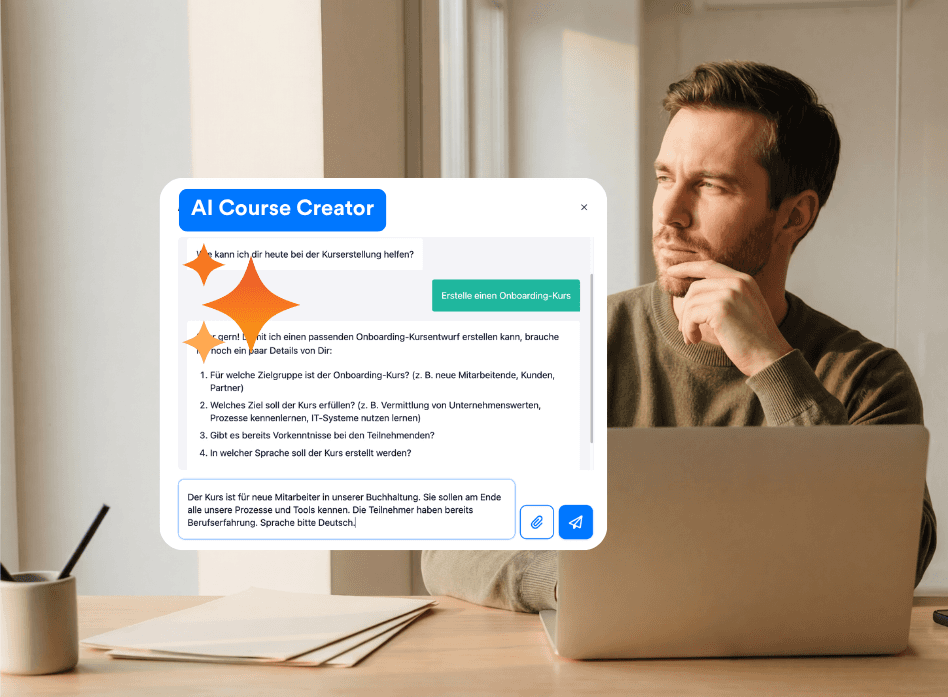
A particularly practical use of AI in e-learning is support with course creation. Instead of starting from scratch, AI develops a structured course template with chapters and learning units from your course topic. This means you don't just use AI selectively in the course, but directly for building your entire training program.

What AI cannot do, and why that matters
As powerful as AI has become, there are clear limits to the use of AI functions that HR teams and companies should be aware of:
1. AI does not make strategic decisions.
It can make suggestions, but it cannot set priorities or evaluate corporate goals.
2. AI does not replace the didactic concept.
AI can support and supplement learning content, but it cannot compensate for a lack of structure or unclear learning objectives.
3. Every AI is only as good as the data it was "trained" with.
AI can only work with what is provided to it. Accordingly, poor or incomplete learning material has a direct impact on the results the AI delivers.
4. AI needs clear framework conditions.
Especially in learning, data protection is a major topic. When using AI functions in e-learning, your company should clearly define which content may be processed by AI and which may not.
In short: AI is a tool. Its usefulness is determined not by the technology itself, but by how consistently and sensibly you use it.
Benefits for companies: Why AI-supported learning is convincing
Used correctly, AI tools and functions deliver noticeable added value. The most important benefits:
✔️ Less effort for HR and trainers
Standard questions, feedback, evaluation, summaries: many time-consuming tasks run automatically. This creates space for personal support of learners.
✔️ Better learning outcomes
Immediate feedback, personalized learning paths, and clear explanations ensure that learners progress faster and less often give up.
✔️ Higher learner motivation
When questions are answered directly and content is easier to understand, participants feel supported. Courses then feel less like a “duty” and more like real help for everyday work.
✔️ Scalability for large teams
AI is available at any time and does not take more time when 50 or 500 people are learning at the same time. That makes corporate learning more predictable – and more affordable.

How companies can get started with AI – pragmatically and without complex IT projects
Many decision-makers within a company immediately think of extensive IT system integrations when introducing AI tools . In practice, however, it is often enough to start small at first and observe for a while how the use of AI features really feels and how much acceptance they find among users.
Here are three realistic entry paths:
1. Activate AI support directly in the course
Modern learning platforms offer AI coaches that can be integrated directly into existing courses. Answering questions, giving feedback, explaining content – all of this happens without technical hurdles.
2. Improve learning content with AI
Whether summaries, review questions, or microlearning formats: AI can quickly optimize existing learning material without the need to create new content.
3. Automate processes in continuing education
Reporting, feedback, evaluation: many tasks can now run with AI support and without additional tools.
Important: Start with one use case. Not all ideas have to be implemented at once.
What really matters in implementation
AI provides the technology. Whether it actually works in your company is determined by clear rules, clean processes, and responsible use.
1. Transparency
Employees or course participants must understand what AI is used for and how they benefit from it. The clearer the communication, the greater the acceptance.
2. Data protection
Especially with AI systems, the rule is: work only with GDPR-compliant solutions and clearly define how content is processed.
3. Didactic quality
AI can support and complement learning content. However, whether learning really works continues to depend on clear learning objectives, a clean structure, and content prepared in an understandable way.
Conclusion: AI-supported learning is no longer a future topic
💡 AI-supported learning sustainably increases the value of in-company training when it is embedded didactically, strategically guided, and used responsibly.
Artificial intelligence is long since more than an experiment in corporate learning. It can accelerate learning processes, automate routine tasks, and enable individual support. Companies benefit most when they define concrete use cases and use the technology specifically where it creates real added value.
The key is balance: AI takes over analysis, feedback, and structuring, while HR, trainers, and managers remain responsible for content quality, strategic direction, and personal support.
Anyone who clearly defines this framework turns AI into more than an isolated feature; it becomes a fixed part of modern learning processes. This creates training that remains efficient, scalable, and human at the same time.

Frequently asked questions and answers
How does AI-supported learning differ concretely from classic online courses?
The biggest difference lies in active support during learning. While classic online courses are built statically and learners are often left on their own when they have questions, AI responds dynamically to the behavior of course participants. It answers questions in real time, gives individual feedback, and adapts content to learning progress. This creates a much more interactive and supportive learning experience.
When is the use of AI in corporate learning really worthwhile?
The use is worthwhile especially when specific bottlenecks exist, for example in supporting many course participants, in time-consuming feedback, or in evaluating learning progress. AI adds particular value where processes are to be scaled or quick support is needed. Without a clear use case, however, the effect often remains small.
Which tasks should AI take over in the learning process, and which should it not?
AI is particularly well suited for recurring and time-consuming tasks such as feedback, evaluations, summaries, or answering standard questions. It is not suitable for strategic decisions, didactic design, or the evaluation of corporate goals. These tasks remain with HR, trainers, and leaders.
How can a company pragmatically get started with AI-supported learning?
A sensible entry is achieved through individual, clearly defined use cases. For example, an AI coach can initially be used in existing courses, or existing learning material can be improved automatically. The important thing is not to implement everything at once, but to start with a concrete scenario and expand the use step by step.