Anyone creating an online course doesn't have to start from scratch. Presentations from training sessions, webinars, or internal workshops often already contain valuable content. However, simply copying slides 1:1 into an online course is rarely a good solution. This is because presentations are designed for an accompanying verbal explanation.
In this article, we will show you step-by-step, using an example, how to transform existing presentations into a modern online course and develop diverse digital learning content from existing materials.
Therefore, ask yourself the following question before you use your presentation slides in an online course:
What is your goal in e-learning?
At the beginning of every learning method is the question of the goal: What do you want to achieve with your online course? Only when the goal is clear should you focus on the content. And at the very end comes the format, which you can then adapt to the goal and content:

A presentation is initially just a format. It is suitable for live talks, where you can verbally explain what each slide is about. That is exactly what is missing in an online course. If you copy presentation slides one after another into your course, your participants will lack context.
This brings us to the next question:
When should you use presentations in online courses?
First of all: Purely copying & pasting presentation slides into online courses is rarely a good idea. Especially if you want to achieve a change in behavior with your e-learning. This is because individual slides convey information but allow for very little interaction, application, or immediate feedback. For an effective online course, they should therefore be combined with other learning formats.
Instead, use individual slides of the presentation for your online course. And select each slide carefully: Content where you want to show an image or present a quote is wonderfully suited. Then supplement these slides with additional online content to provide context. Let’s simply go through this step-by-step with an example.
Example: Transform your presentation into an online course!
For our example, I am using a presentation from a colleague who recently gave a presentation on the topic of learning culture in companies as part of a webinar. This is what the presentation for the webinar looked like:
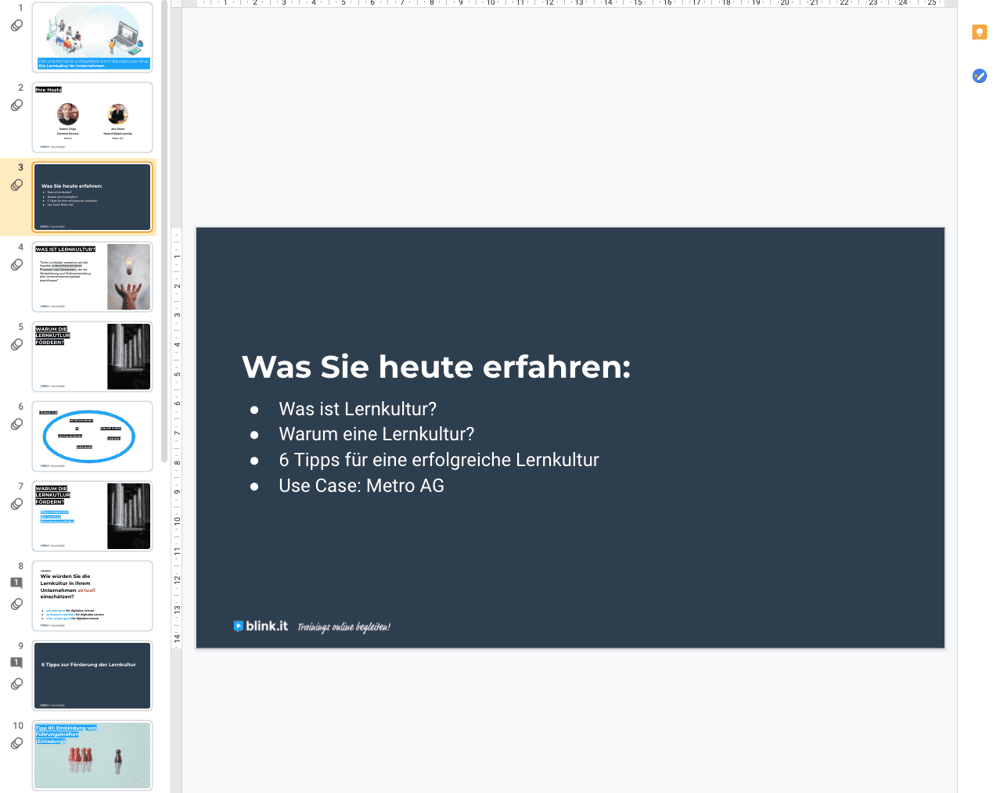
Now we want to build an online course from this presentation. On the left side of the image, you can see the individual slides of the presentation. Open on the right is the typical introductory slide, which shows what his presentation is about. This slide is the ideal starting point for transforming the presentation into an online course.
Step 1: Choose suitable formats for the content
In any good presentation, you will find a kind of table of contents at the beginning, as shown above: What is the presentation about, what are the different topic points? Write down the individual points and consider which format would be suitable for each. Remember: Content comes first, then the format! You already thought about the goal of the entire course right at the beginning and should always keep it in mind.
In our example, the following formats are suitable for the content:
What is a learning culture?
The text definition can be reused as a slideWhy a learning culture?
Personal context, ideally as a video6 tips
Use slide images as thumbnails, then explain via videoUse Case
Integrate as a link to the use case followed by a quiz
Step 2: Make a plan
Once you have thought of a suitable format for each piece of content, you should make a rough schedule: What is the easiest thing to start with? Do you perhaps need another person for some content? Or a special tool, such as a microphone and tripod for a video? Plan now what you will do when and directly set up appointments with external people if necessary.
In our example, the point "Why is a learning culture important?" is suitable as a short video of a manager. This gives the topic a personal connection to the company and places it in a better context for the participants. If you want to use an image from external sources for the use case, you should request it in good time. Make an appointment in your calendar for both requests before continuing with the remaining content in the online course.
Step 3: Transform presentation content into course content
Once everything is planned, you can start implementing it in the online course. Now transform the presentation step-by-step into suitable course content. In our example, it could now look like this – each blue tile is a learning unit:

Example: The presentation shown above was transformed step-by-step into an online course with blink.it.
You can already see in the screenshot shown that some content goes beyond the pure presentation: For example, chapters are suitable for structured structuring of the course. This brings us to the last step in turning a presentation into an online course!
Step 4: Optimize the course towards the goal
As explained at the beginning, a presentation is a format for live verbal events. An online course, on the other hand, is time-independent and offers numerous additional possibilities for using media. Therefore, at the end, be sure to think about your goal once again and optimize your course accordingly. Where can you increase interaction? How do you ensure that your participants remember and apply what they have learned?
In addition to text, images, and video, you can use interactive elements such as quizzes, surveys, or short knowledge checks. They help actively involve participants and check whether key content has been understood. If the learned material is subsequently to be applied in daily work, concrete tasks and calls to action are also suitable.
In our example, a survey at the end of the chapter is suitable, asking how many of the tips the participant would like to implement in the future. We also supplement the online course with another chapter, which is wonderfully suited for the e-learning format: "Now it's your turn!". In this, we integrate a quiz to ensure that the participants have internalized the learning content. We also give concrete calls to action on how the participants can apply what they have learned in their daily lives.
In addition to presentation slides, a variety of formats are suitable for online courses. Think "out of the box" and consider: Which formats fit your goal and your content?
Conclusion
An existing presentation is a good foundation for an online course, but it does not replace pedagogical preparation for digital learning.
The key is not to simply transfer the slides, but to restructure content based on the learning objective and select the appropriate format for each topic.
This allows existing materials to be reused efficiently and simultaneously supplemented with videos, quizzes, tasks, or other interactive elements. From a presentation originally created for face-to-face training or a webinar, an independent online course is created step-by-step.

Frequently Asked Questions and Answers
Can you use a PowerPoint presentation directly as an online course?
A presentation can serve as a foundation, but it should not simply be adopted 1:1. Slides are usually designed for a talk with additional verbal explanations. For an online course, the content must therefore be restructured and supplemented with suitable digital learning formats.
How do you transform a presentation into an online course?
First, the learning objective and relevant content are defined. Subsequently, a suitable format is chosen for each piece of content, for example text, image, video, quiz, or task. Then, the materials are implemented and the completed course is optimized in terms of interaction and application.
Which content of a presentation can be easily reused?
Individual graphics, images, definitions, quotes, and clear diagrams are particularly suitable. Content that is explained in detail verbally during a presentation requires additional context in the online course.
How do you turn existing slides into an interactive online course?
Presentation slides can be combined with videos, quizzes, surveys, knowledge checks, and concrete tasks. As a result, participants do not just passively consume the existing content, but actively engage with it.