“Do I need an additional authoring tool with blink.it to create my learning content?” We hear this question again and again. That is why we want to show you why blink.it is more than a classic LMS! Learn everything about the e-learning platform and why, thanks to blink.it, you no longer need an additional authoring tool.
Authoring tool and LMS – what is the difference?
In the field of e-learning, the question repeatedly arises: authoring tool, LMS, or another e-learning software? Especially when e-learning is to be newly introduced in a company, HR managers are not always clear about what kind of tool is actually being sought.
What you decide on depends on your requirements. If you are currently looking for a suitable e-learning tool, you should know the difference between an authoring tool and an LMS:
Main functions of an authoring tool
Authoring tools help you create varied content and entire e-learning courses.
Content: With images, texts, videos, and interactive elements, you can create e-learning courses for a wide variety of topics.
Templates: Most authoring tools offer you the opportunity to create your own templates and reuse them for different learning content.
Management: Authoring tools also offer management options, but these primarily relate to your learning content and resources.
Interaction: Digital learning thrives on exchange, which is why most authoring tools have special quiz or survey functions for course design.
Digitization: To use existing offline content in e-learning, many authoring tools offer special functions for digitizing materials.
Main functions of an LMS
A Learning Management System (LMS) helps you manage and distribute e-learning courses to your course participants.
Organization: An LMS not only helps you plan and structure your e-learning, you can also send course invitations and reminders.
Management: In the LMS, you can track the activities and learning progress of your participants and send reminders if necessary.
Evaluation: For each participant, you can view the completion status and send reminders if necessary.
Integration: Most LMSs can be easily connected with videoconferencing tools and other applications from Google or Office.
Assessment: Thanks to certain evaluation functions such as quizzes or reports, you can evaluate the learning success of your participants.
Reading tip: Today there are many different types of LMS with different focuses. We explained the difference in detail here: What is the difference between LMS, LCMS, and LXP?
Important: You may need both an LMS and an authoring tool. This depends on the respective tools: some LMSs have no option to create content at all and absolutely require an authoring tool. Likewise, there are authoring tools that have no participant management and must be integrated into an LMS. Therefore, when choosing tools, make sure whether they depend on each other or, like blink.it, work "stand alone".
blink.it – The perfect mix of authoring tool and LMS
We often describe blink.it as "LMS light". This does not mean that blink.it has fewer functions than a classic LMS. On the contrary: blink.it offers everything you need and still remains clear and structured! Pure LMS solutions are often "spaceships" with a multitude of functions that you don't even need in everyday life. With blink.it, "As much as necessary, as little as possible" applies.
With blink.it, you have an authoring tool and LMS in one. To clarify what we mean by this, we have created an overview: In the table, you can see all blink.it features summarized, divided into LMS and authoring tool functions:
blink.it LMS functions | blink.it Authoring tool functions |
Participant management
| Content creation
|
Learning support
| Interaction
|
Evaluation
| Communication
|
Technology
| Flexibility
|
SCORM integration
| Bonus function: Selling
|
Example: How practical blink.it authoring tool & LMS functions are
Of course, we don't just want to talk about the diverse functions of blink.it, but also show them to you. That's why I'm introducing my six favorite functions of the blink.it platform, from content creation to course management.
1. Create your e-learning course directly in the learning platform
Create your own e-learning with blink.it in just a few clicks. Thanks to the clear tile layout, you have all the content directly in view.
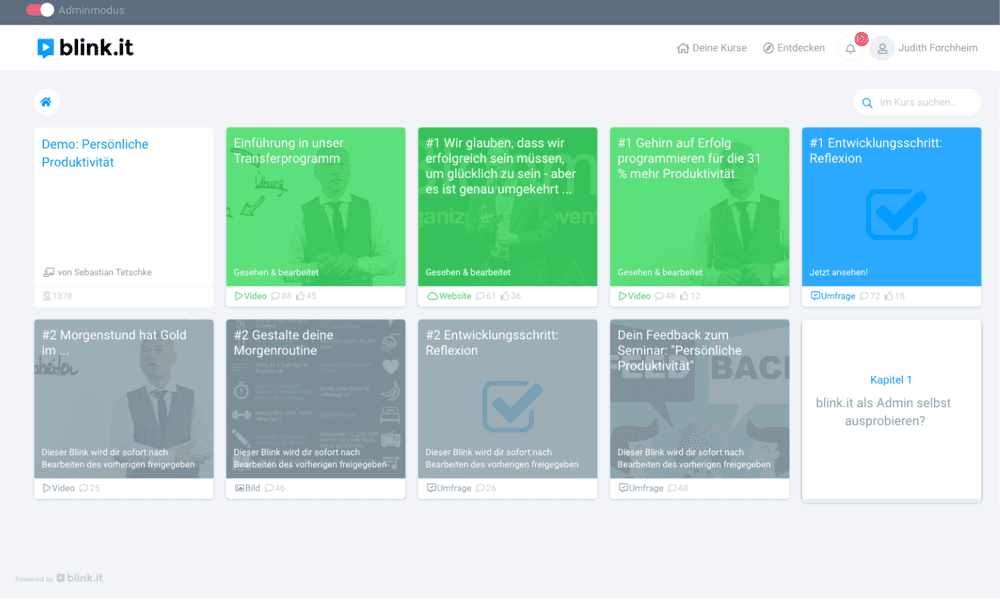
blink.it course overview: Build your own online course directly in the learning platform. // Source: blink.it
2. Choose a variety of media for your e-learning course
Use different media that fit your learning content. This makes e-learning fun and more effective at the same time. Find the media mix for your e-learning now!

Design your e-learning with a mix of videos, images, texts, and further links. // Source: blink.it
3. Send your participants regular emails directly from your course
Contact your e-learning participants regularly via email. Welcome your participants comfortably by email before the start of the course and remind them regularly to continue working on the online course.

Regularly send targeted messages as reminders and keep in touch with your participants. // Source: blink.it
4. Check in the statistics how far along your participants are with the course
Trust is good, monitoring is sometimes better. Check your course statistics regularly to see how far along your participants are with processing. This way you know when your next reminder email should be sent.

Keep an eye on your course participants' learning progress. // Source: blink.it
5. Promote the exchange between participants and answer questions
The exchange of knowledge and discussions are particularly important in e-learning. Ask and answer questions directly below individual learning contents. You can upload files or rate posts with a thumbs up or down.
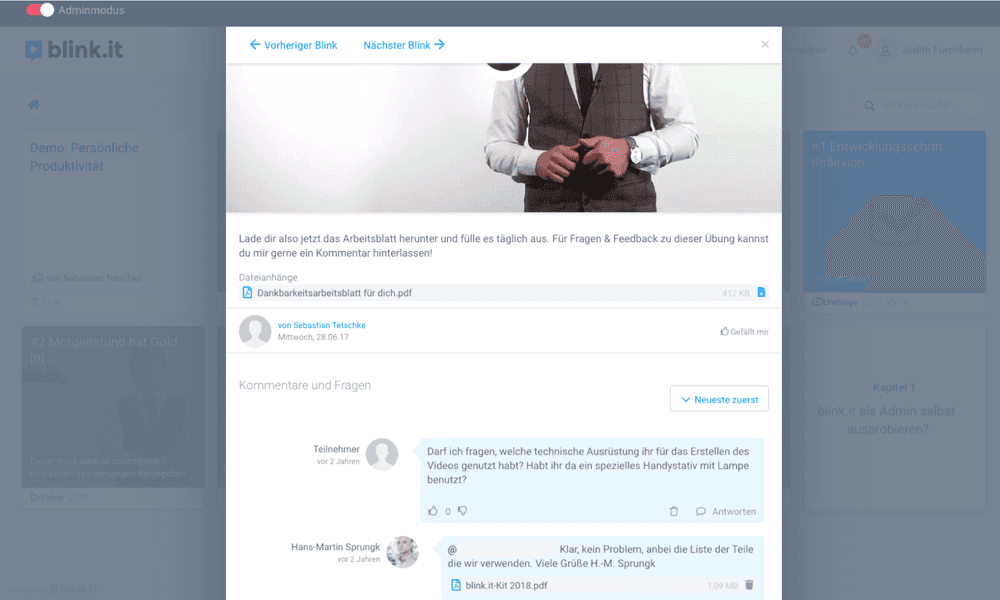
Under learning contents, there is the opportunity to exchange ideas in the comments. // Source: blink.it
6. Complete learning units or your entire course with a test
There are many question types and settings for how you can test your participants' knowledge. Tests, quizzes, or surveys – you can also create these anonymously, as in this example.
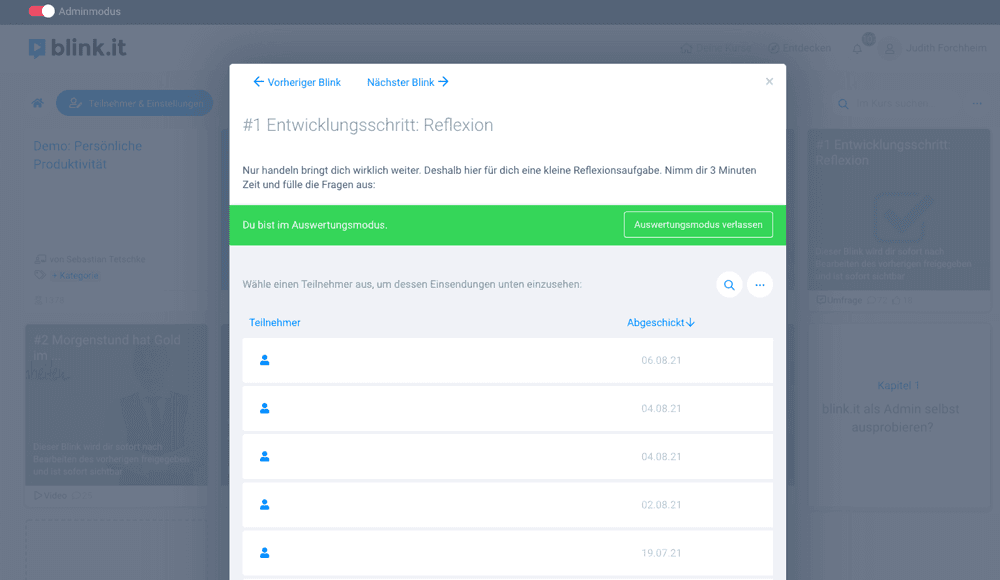
Evaluate your tests and quizzes to assess the success of your course participants. // Source: blink.it
Did you enjoy these insights and want to learn more about blink.it now? Then book a free demo now and learn about the advantages for your usage. Test the blink.it platform as an LMS and authoring tool directly in the demo course that you saw in the examples here, non-bindingly from a participant's perspective. Have fun!