How can employees continue their training even when their schedule is full? Workflow Learning integrates learning directly into the work process: employees receive support precisely when they need new knowledge for a specific task. This can be short learning content, instructions, videos, or even digital and AI-supported assistance systems. Find out how learning works in the "Moment of Need" and how companies make knowledge available directly at the workplace.
Regular further training remains important. However, not every knowledge gap requires a training session or a comprehensive online course. Often, employees need specific information at the exact moment they are performing a task. Workflow Learning therefore connects learning and working with each other and enables new knowledge to be applied immediately.
Learning in the Moment of Need
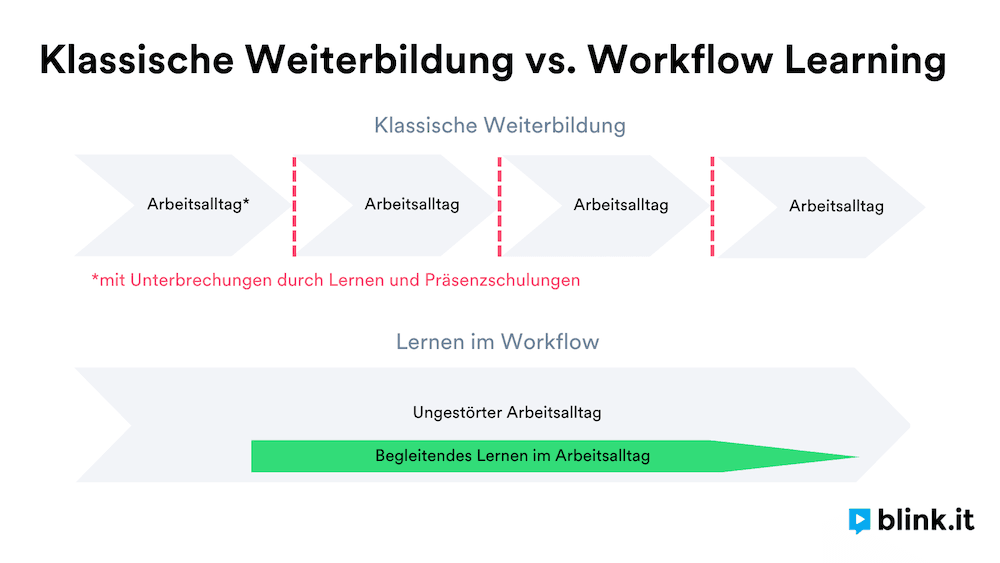
Classic further training and Workflow Learning fulfill different tasks. While training sessions and online courses, for example, systematically convey new knowledge and skills, Workflow Learning supports employees directly during a specific task in the work process.
If employees encounter a knowledge gap during their work, a "Moment of Need" arises. Now they need the right support as quickly as possible, for example, a short guide, an explanatory video, a checklist, or a digital assistant. The decisive factor is that the required information is easy to find, understandable, and immediately applicable.
Info: The "Moment of Need" refers to a moment of demand when employees need knowledge or support to complete a specific task or solve a problem.
An example: Imagine you want to use a certain formula in Excel at work and no longer know how it works. You do not need training for this single knowledge gap, but a quick, specific answer.
Today, this support can look very different: perhaps you will find a short guide in the internal knowledge database, an explanatory video on the learning platform, or you can ask an AI assistant used in the company. So-called digital adoption solutions can also guide employees step-by-step through a process directly within a software.
The format is less decisive than quick access: The appropriate information should be available where employees need it. This ensures that work is interrupted as little as possible and new knowledge can be applied immediately.
Implementing Workflow Learning in the Company
If certain questions or work steps occur regularly in the company, it is worth making the required knowledge centrally available. Short learning units, guides, checklists, videos, or step-by-step explanations, for example, are suitable for this. More extensive processes can also be mapped in online courses.
A learning platform can serve as central access to relevant learning knowledge. However, it is important that employees can find the required content quickly and use it as close to the specific work situation as possible. In this way, further training becomes an integral part of the work process instead of an activity separate from it.
Digital learning content has the advantage that it can be provided centrally and used over and over again. In this way, for example, new employees can be brought to a common level of knowledge or recurring questions can be answered. However, it is important to check the content regularly and update it when processes change. Especially with frequently required knowledge, this effort is worthwhile because updates are then available to all employees.
4 key benefits of Workflow Learning
Workflow Learning brings further training exactly where new knowledge is needed: into daily work. Particularly with specific questions, recurring processes, and practical tasks, this form of learning support can sensibly supplement classic further training offers.
Time-saving: Employees receive the required information directly in the work process and do not have to complete a separate training course for every knowledge gap.
Independent work: Easily accessible knowledge helps employees to answer many questions independently and complete tasks more securely.
Direct practical relevance: New knowledge is not learned in advance, but can be used immediately for a specific task.
Support during onboarding: New employees can access guides and learning content exactly when they perform certain processes themselves for the first time.
Conclusion
Workflow Learning makes further training a part of daily work by allowing employees to access suitable knowledge exactly when they need it for a specific task.
Learning and working do not have to be separate activities. Short learning content, guides, videos, knowledge databases, or digital assistants can support employees directly in the "Moment of Need".
For companies, this means: Knowledge should not only be conveyed, but should be made easily accessible and provided as close to the respective work situation as possible. In this way, Workflow Learning supplements classic further training and creates a direct path from the required knowledge to practical application.

Frequently Asked Questions and Answers
What is Workflow Learning?
Workflow Learning refers to learning that is integrated directly into the work process. Employees access knowledge or learning opportunities while performing a specific task and requiring support. As a result, learning and working no longer take place completely separately from each other.
What does "Moment of Need" mean?
The "Moment of Need" is the point in time when an employee needs knowledge or support for a specific task. Instead of learning the required knowledge long in advance, they receive, for example, a guide, a short learning module, or other suitable assistance in the moment of need.
Which content is suitable for Workflow Learning?
Particularly suitable are short and immediately applicable contents such as guides, checklists, explanatory videos, step-by-step explanations, or short learning units. Knowledge databases, AI assistants, and digital adoption solutions can also support employees directly in the work process.
What advantages does Workflow Learning offer for companies?
Workflow Learning enables quick access to required knowledge, supports independent work, and connects learning directly with practical application. Recurring questions and processes can also be documented centrally and made available to many employees.
Can Workflow Learning replace classic further training?
Workflow Learning is primarily a supplement to classic further training formats. Comprehensive training courses and online courses continue to be suitable for the systematic building of knowledge and skills. Workflow Learning, on the other hand, supports employees particularly with specific questions and tasks in daily work.