A good onboarding process is essential for new employees – but how can onboarding work despite social distancing? We provide five tips for onboarding in the home office:
An intensive onboarding is a challenge for many companies even in normal times: Often there is a lack of a plan or simply the personnel capacity for comprehensive support for new employees. In the current crisis, where social distancing has the highest priority, you as an HR person might be facing the double challenge: Good onboarding, and that without personal contact.
Digital onboarding can also be relevant in other situations, for example when your company hires remote employees or when you need to onboard employees at other locations.
Therefore, we want to answer the two most important questions: Why is comprehensive and well-thought-out onboarding so important? And how do you achieve onboarding completely digitally?
That’s why onboarding is so important for new employees
1. Your new employees are more satisfied
Especially in the initial phase, it is important to convey a sense of belonging to new team members. If the first weeks are well-prepared, the "newcomer" immediately feels part of the team and can focus on the important things: working and integrating into the team.
2. Employees stay longer in the company
According to the LinkedIn Workplace Learning Report 2019, 94% of employees would stay longer in a company if it invested more in the training of its employees.
Reading Tip: We have already summarized the four most important learnings from the Workplace Learning Report 2019 for you.
3. Employees can perform better
Employees who are well-onboarded can work more independently and efficiently at a faster pace. To make individual support in onboarding easier, you should look at the individual skills of your new employee and consider which are particularly important for the new position – and promote these specifically.
4. Learning transfer is sustainably better
If you plan the onboarding of your new employees over a longer period of time (for us, it is usually 3 - 4 weeks), the learning effect is significantly higher, and the newly acquired competencies and content are applied directly.
5. Continuous training is established right away
If you promote the skills of new employees from the very beginning, they immediately feel well prepared for the new responsibilities. Make it clear from the start that learning and training are part of the general company culture.
Reading Tip: We have already reported in the blog on how you can make the learning culture of your company visible.
Save time through blended onboarding
Onboarding has many advantages. However, onboarding new employees is often associated with high time expenditure and incurs additional costs due to colleagues’ extra work or the provision of documents for the new employee.
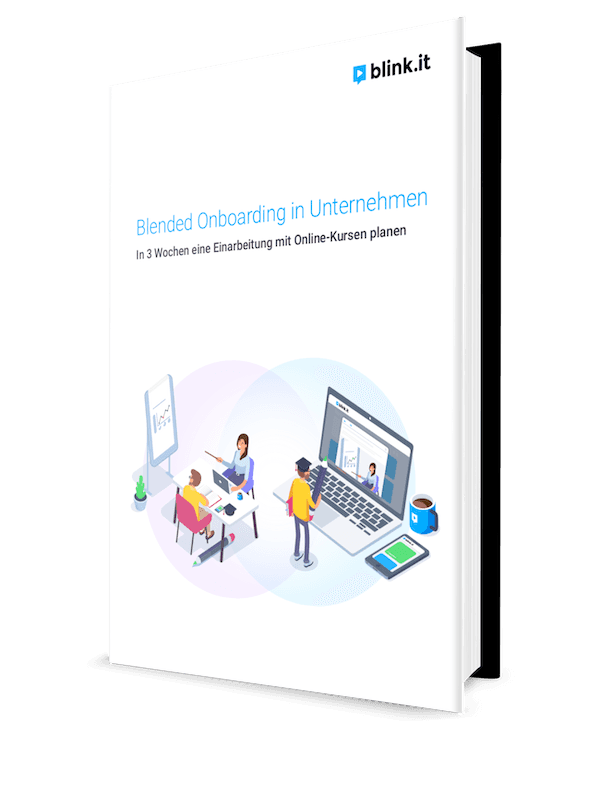
For this, there is a simple solution that we have developed and established in the blink.it team: Blended onboarding! With the method, you convey your most important content on the one hand in an online course and on the other hand in personal sessions. Take our free guide in hand and start planning your blended onboarding right away:
Blended onboarding despite social distancing
Blended onboarding does not necessarily have to take place on-site; it also works wonderfully completely remote. Similar to blended learning, you can easily move the on-site part to a digital space and implement it there as usual.
This experience we have made ourselves: Our new Blinkie Sandra has been with our team since the beginning of March. Shortly after, we voluntarily went into home office due to Corona, and her onboarding had to take place digitally. Of course, it was planned differently, but it works wonderfully even completely digitally!
However, designing the onboarding of new employees completely online also has some advantages after the Corona period. As already mentioned: Not every new employee will work at the same location as you or may not be in the same office every day. In cases where personal contact is not possible, you can easily hold many of your onboarding sessions online. You will see that your onboarding works effectively even completely digitally!
If you want to design the next onboarding according to the principle of blended onboarding, you should keep in mind the following five tips:
5 Tips for Completely Digital Blended Onboarding
1. Use suitable software or app to provide your content
For new employees, it is especially important to have a central place with all relevant information – ideally in the form of an appropriate app like blink.it. There you can upload information about everyday work and company culture before the first day. Structure the task packages for the first weeks in this way and release them gradually.
2. Establish communication tools directly for new employees
Many companies today already use communication tools like Google Teams or Slack. Therefore, invite new employees directly to all team or chat tools and motivate other employees in advance to approach the new employees directly. Questions can also be directed to the entire team.
3. Assign a contact person for your new employees
Whether onboarding at the workplace, “blended” or fully digital: you should definitely plan for a fixed contact person. Ideally, this person is from the same department as your new employee. This way, you offer the “newcomers” the opportunity to ask direct questions.
4. Facilitate regular employee meetings and feedback
Here, communication is also the key to success, especially if your onboarding takes place completely digitally: Plan regular meetings, listen to the experiences of new employees, and try to resolve issues as quickly as possible. Also, ask other employees for feedback! At the same time, you can give feedback directly, even without personal presence. Our favorite tool for online conversations and feedback is “Zoom.”
5. Have new employees keep a video diary
A video diary is a fixed part of blended onboarding, allowing new and existing employees to get to know each other better. For the new employee, it is also a good way to reflect on the day's experiences. Ideally, you upload the videos centrally so that your other employees can watch them online and provide feedback!
With these tips, your onboarding can also take place without personal contact. Keep in mind especially the first tip: The ideal online tool! If your technical foundation is right, the rest of your onboarding will succeed as well. Therefore, we, and many other companies, swear by blink.it – with this platform, you create the foundation for successful onboarding.
Do you want to test this platform? Then book your free admin demo at blink.it now and convince yourself of the comprehensive features of our platform.