In many companies, a wild growth of learning methods and tools is developing. Coordination and keeping track is becoming increasingly difficult for HR managers. The learning ecosystem approach provides a remedy. Learn what it is and what advantages it brings in this article.
In-person events, e-learning, microlearning, webinars, and many more – all of these methods are popular in companies. And each has its strengths and weaknesses. Many companies use multiple methods directly, which is fundamentally good and sensible.
However, a sensible combination of methods can also quickly result in a "wild growth" of tools, platforms, and formats. The consequences: coordination becomes difficult, track of technologies is lost, and employees as well as managers are increasingly disoriented. And along the way, the goals of the individual measures are also lost.
A relatively new approach can provide a remedy: view learning in companies as learning ecosystems (or "learning ecosystems") that connect all elements and actors towards a common goal.
Definition: What is a learning ecosystem?
The term is not self-explanatory, so let's start with a short definition!
Excursus: Ecosystems in nature and business
The basis is the ecosystem as we know it from the natural sciences:
An ecosystem consists of a community of organisms (...) and their non-living environment"
(Wikipedia)
An ecosystem therefore holistically unites different living beings in a shared habitat. All participants exchange with one another and influence each other.
This principle can also be transferred to business ecosystems: Many different actors in the company act within the shared environment (the company), with a common goal: to achieve a greater value creation as a whole than the individual elements can on their own. Actors can be human beings, but also machines and technologies.
Transfer: Learning as an ecosystem
A learning ecosystem unites all relevant elements for learning in companies:
People, for example HR and IT managers, employees, teachers, and executives,
Technologies such as learning and communication platforms, necessary devices, and technical processes,
Behaviors, structures, processes, and interaction,
all other elements that are important for "learning" within the company.
In every company, a learning ecosystem develops automatically (and often unconsciously) over time: this ranges from "wild growth" to mature and specifically designed systems. The task of modern personnel development is to discover, analyze, and sensibly develop the learning ecosystem further.
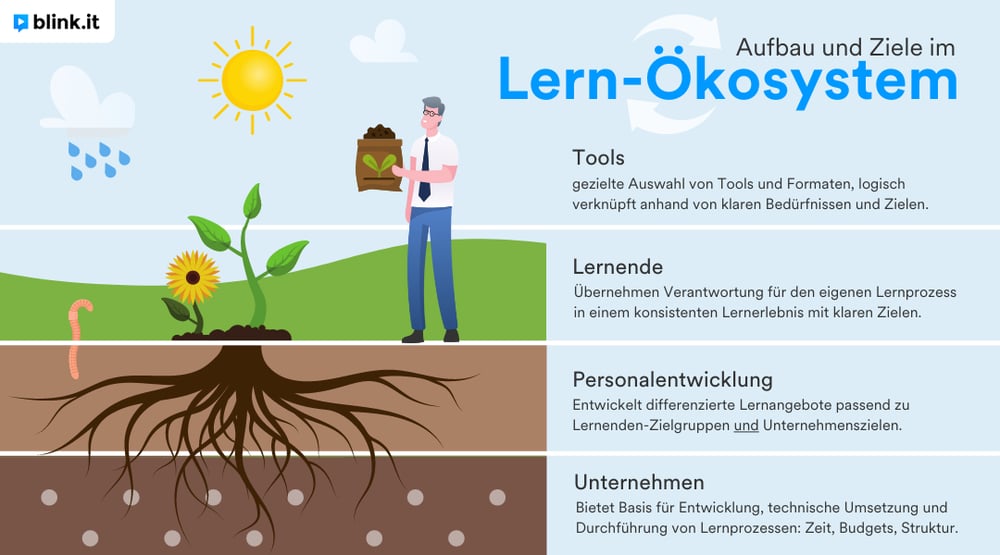
Structure and goals in the learning ecosystem: From the company via personnel development and learners to the tools.
Advantages: What are the benefits of a learning ecosystem?
You should take a closer look at the following 5 advantages of a learning ecosystem, especially as an HR developer:
Manageable decentralization: Learning is becoming increasingly digital and thus independent of time and place. More and more digital tools and groups of people must be integrated for digital training to succeed. Classic processes in personnel development reach their limits here. The learning ecosystem approach brings all elements together in a meaningful way. This relieves personnel development and makes the decentralized "learning system" manageable and controllable.
Common goal setting: A business ecosystem always requires a common goal of all participants. With a clear goal for all learning processes in companies, many things become easier: the selection of tools and methods, the division of roles and responsibilities. If all participants (personnel development, executives, employees, trainers, etc.) agree on what they want to achieve, friction points are also reduced. And the motivation for cooperation increases.
Higher resilience: An ecosystem is not a rigid construct, but always in change. This also leads to a higher adaptability to new situations in the learning context (as shown, for example, by the Corona crisis). A well-functioning learning ecosystem can quickly accept new conditions and align itself accordingly without being damaged. Meaning: less stress for all involved.
More responsibility for individuals: There is no organism in ecosystems that does not perform a function and task. All are important. In the learning ecosystem, too, every actor has a clear role. And with that, clear responsibilities. If the roles are clear, the responsibility for the entire learning process can be clearly distributed. On one hand, this relieves the HR department. And on the other hand, it gives employees more co-responsibility up to co-creation of their learning processes.
Clear orientation: Clear structures, a common goal, a clear role, and own responsibility – all this helps employees to find their way around the learning ecosystem. The result: less confusion and higher learning motivation among learners and a simpler organization for HR managers.
In order for a learning ecosystem to work permanently, tools, processes, and learning formats should be regularly reviewed and consolidated. Without clear prioritization, duplicate structures, unnecessary license costs, and untransparent responsibilities quickly arise.
Conclusion
A learning ecosystem is not a toolset, but a strategic structure that aligns people, processes, and technologies toward a common goal.
Instead of isolated individual measures, a consciously designed learning ecosystem creates a clear framework for further development. Roles, goals, and responsibilities become transparent, digital tools are integrated in a meaningful way, and learning processes are stabilized in the long term.
Those who reduce wild growth and think about learning systematically create orientation, efficiency, and sustainable impact in the company.

Frequently Asked Questions and Answers
What is a learning ecosystem?
A learning ecosystem describes the interplay of people, processes, technologies, and learning formats within a company. All elements work towards common learning and company goals.
Why do cluttered learning landscapes often develop in companies?
Over time, new tools, platforms, and learning formats are added. Without a common strategy, duplicate structures, unclear responsibilities, and unnecessary complexity arise.
What advantages does a learning ecosystem offer?
A structured learning ecosystem creates transparency, clearly distributes responsibilities, facilitates the selection of suitable learning methods, and improves cooperation among all participants.
Who belongs to a learning ecosystem?
In addition to the learners, this includes personnel development, managers, IT, trainers, as well as learning platforms, communication tools, and organizational processes.
How can a learning ecosystem be successfully developed further?
Companies should regularly review their learning processes, define roles clearly, consolidate unnecessary tools, and consistently align all measures with common learning goals.