
Would you like to improve your training measures and are you looking for new methods – for online and offline? Then try the sketchnote method and design your next learning unit in a creative and sustainable way.
Doodling as a creative learning method?
We say yes! Because: humans mostly think in pictures, but only speak in concepts and sentences. This often makes it difficult for us to remember solely spoken content. So-called sketchnotes can be a good support here, because they present knowledge in a simplified way. They fulfill the task of making content more understandable. As a trainer, you can use this method, for example, to process the central points of the last meeting in the form of sketches and individual terms in order to bring them closer to your course participants and recall them to their minds.
But what actually are sketchnotes? It is a creative form of note-taking. Most of the time these consist of small drawings or doodles that can be used instead of – or combined with – text. In particular, complex subjects can be visualized with the help of a clever mix of images, texts, and structures and are more easily accessible to learners.

Represent complex content in a simplified way with sketchnotes.
Three reasons why you should give sketchnotes a chance
Double anchoring in memory – By combining visual and textual content, the engagement with a topic is promoted. This contributes to comprehensibility, as different access points to the discussed content are made possible.
Automatic filtering of information – Sketchnoting forces your participants to select the perceived content, which makes the notes more precise and meaningful.
Active listening – Thanks to this method, learners automatically listen better because they can focus on a visual note-taking format and do not have to copy your words word for word. This directs the focus to important core statements.
You can use the sketchnote method in different ways
It is particularly helpful when remembering content, as sketchnotes are a good alternative to common protocols because they narrow down facts to their core statement.
Understanding new content is also easier, as the learner can quickly get an overview of a topic in this way. And along the way, you appeal particularly strongly to visual learning types!
During an in-person event, sketchnotes can increase your participants' engagement, as drawing along requires active listening.
Last but not least, we recommend the sketchnote method for the development of new thoughts, ideas, and concepts, also in group contexts.
A tip for you: Why not use sketchnotes to follow up on your last in-person event in order to visually illustrate the most important content for the course participants? Or let your participants brainstorm for the upcoming lesson using this method!

Sketchnotes as a suitable method for creative brainstorming.
Basic elements for your first sketchnotes
In principle, you can build your sketchnotes however you want. All that matters is that you make notes that you understand! A simple sketchnote can, for example, consist of an image and individual words. If you want to make them more complex, the following elements are ideal:
Bullet points to bring more structure to short lists
(e.g., dots, checkmarks, ...)Boxes or containers to highlight individual statements
(e.g., speech bubbles, signs, ...)Separation and connection elements to show relationships or differences
(e.g., arrows, lines, curly brackets, ...)Symbols to clarify important insights
(e.g., light bulb, flags, ...)Typography to label headings more clearly
(e.g., bold text, borders, ...)Figures to make content more human
(e.g., stick figures, smiley figures, ...)Emotions and faces to increase the expressiveness
(e.g., happy face, sad smiley, ...)
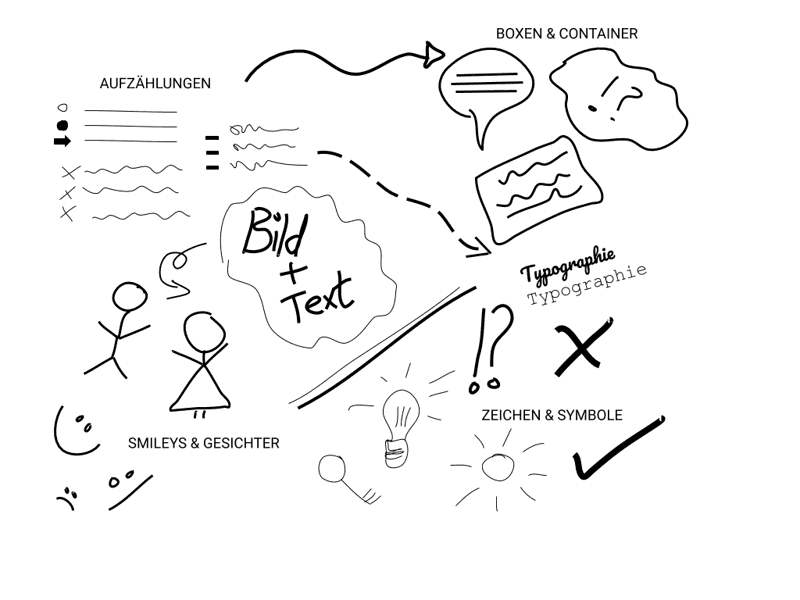
This is how your sketchnotes could look, for example.
Remember the basic rule: "Ideas, not Art!" – because sketchnotes do not have to be beautiful, they merely serve as a simple summary of different content or results!
Conclusion
Sketchnotes make learning more effective by reducing complex knowledge to the essentials and getting participants to actively process content.
Neither trainers nor participants need to be able to draw. The decisive factor is not the artistic quality, but the understandable combination of terms, images, and structures.
Whether for summarizing, brainstorming, pre- and post-processing, or directly during a learning unit: sketchnotes can be flexibly integrated into different training formats. In this way, a simple doodle becomes a creative tool that makes knowledge visible and more easily accessible.

Frequently Asked Questions and Answers
What are sketchnotes in the context of further education?
Sketchnotes are visual notes that combine texts, symbols, drawings, and structures. They help to present content compactly and make complex topics easier to understand.
Why do sketchnotes support learning success?
By combining images and texts, content is processed through multiple sensory channels. This facilitates understanding, promotes active listening, and improves long-term memory of learning content.
Why are sketchnotes particularly suitable for complex topics?
Sketchnotes reduce content to core statements and make connections visible. This allows even complicated situations to be grasped more quickly and presented in a more structured way.
Do you have to be good at drawing to work with sketchnotes?
No. Sketchnoting is not about perfect drawings, but about understandable visualization. Even simple symbols, arrows, or stick figures are enough to record content effectively.