Make money in your sleep by offering and selling online courses? Many trainers wish for that. But when it comes to selling e-learnings profitably, many face a major challenge. Find out now how to sell your online courses properly!
To heck with the cloud house
Create a stylish course, upload it to a learning platform, invite lots of people to the course, and then sit back and watch it turn to silver all by itself. How wonderful that would be!
Unfortunately, some groundwork is still needed to turn online courses into a nice passive income. In this article, we explain 4 steps for getting your courses to the people. And if you successfully master these 4 steps, then - yes, then it somehow feels as if you are making money in your sleep with your online courses.
The decisive factor for the sales success of your online courses is the content you offer. Adapt it to your customers' needs! It is also crucial how you prepare your content: Is it clearly organized on a digital learning platform like blink.it? Which live or in-person events do you additionally offer? Do the online course packages address customer needs?
To become financially successful with your online courses, 4 steps are necessary.
Step 1: The right sales channel
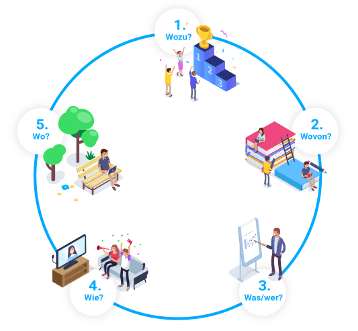
Before you sell your online courses, you should ask yourself how best to address your target audience. Here we give you five suggestions for successfully marketing your e-learnings, which you can adapt individually to your target audience:
1. Sales platform
With a digital learning platform like blink.it, you can create your e-learning offer super easily, and by connecting it to the Digistore24 sales platform, you can conveniently sell your online courses via blink.it. As a trainer, this saves you a lot of time and resources. Once your online courses have been created, you can flexibly decide when they are unlocked for your customers. You also have the option of putting together different online course packages for your customers and customizing your learning offer.
2. Free webinars as a teaser
Offer a free webinar as an introduction to your course: this lets you connect with potential customers in person, they get to know you as the course instructor, and you have the opportunity to convince them personally of your expertise and your online courses. Webinars also have the advantage of being location-independent: you can address a very broad target group, and webinar participants can take part from anywhere with complete flexibility.
But the best thing is that by registering for the webinar, you get the email addresses of your participants. Through these, you contact them directly after the teaser webinar and invite them to the associated online course, which of course costs money from that point on.

3. Social media live streams
Depending on the target group of your online courses, you will also find your customers on social networks. Are your course contents aimed more at younger people? Then focus on platforms like Instagram or TikTok. However, always remember that your online courses should look reputable. Especially on social media, many unqualified trainers offer their online courses, and you definitely do not want to be lumped together with them.
4. Email marketing
How many emails do you get every day that end up in the spam folder or that you delete right away after a quick glance? Email marketing plays a central role in customer acquisition, but you have to stand out from the crowd. Convince your customers with a promotional email that meets these requirements:
Address the recipient personally
Choose a catchy subject line that sparks curiosity
Keep the text short and crisp
Get straight to the point in the first paragraph about what the email is about
Use emoji very sparingly
Leave out all irrelevant information without mercy - less is more!
Include a clear CTA ("Call to Action") in the email: via link or button, through which the recipient can go directly to your course sale.
Also important: funny and entertaining sells better! Think of an advertisement you once remembered yourself. It was either somehow witty or especially appealing. Take a look at other providers' emails and simply browse the colorful world of advertising: there you will find plenty of inspiration you can apply to your case.
5. Referral marketing
Nothing is more valuable than customers who are convinced by your online courses! For this reason, referral marketing is so effective: customers share their good experiences they have already had as participants in your online courses. Therefore, place the utmost value on the opinions of your existing customers and implement their feedback and suggestions for improvement in your courses as quickly as possible.
Step 2: The quality of your courses
What sets your online courses apart from others? The answer to this question is the selling point for your e-learnings. But of course there are more reasons to buy your online courses - provided you can meet all of these aspects:
Practical application instead of lecture-style teaching: Listening and taking notes - many still know that from university and school. But in your online courses, the knowledge is applied directly. If you include additional live sessions (e.g. as a webinar), individual topic blocks can be taught and discussed personally. This significantly promotes learning success because the knowledge is not forgotten so quickly and open questions are clarified immediately.
Benefit from blended learning: While e-learnings convey the content from the perspective of the course instructor or trainer, learners can exchange ideas with each other in cleverly integrated live sessions. On such occasions, topics are deepened once again and personal experiences and insights are shared.
Awaken curiosity about continuing education: To spark potential customers' curiosity about your online courses, it is important to fill them with interesting and as up-to-date topics as possible that give learners a professional and/or personal advantage. If you also spice them up on a learning platform like blink.it with entertaining gamification elements such as a quiz and use clever storytelling in the structure, your e-learnings clearly stand out from the boring mass.
Individual feedback: Successfully completed course chapters motivate people to keep going! On the blink.it learning platform, learners can complete a chapter with a quiz. In this way, you as a trainer can assess their acquired knowledge and at the same time the learners receive feedback on their current learning progress.
Personal support: To address the individual needs, learning behavior, and character of your learners, you can also offer them personal consulting sessions in addition to the online courses. This strengthens the bond, motivates continued learning, leads to better learning outcomes, and not least to greater customer satisfaction.
Consider individual learning pace: Everyone has different learning methods and needs. You must take these into account to achieve the greatest possible learning success. When creating your online courses, therefore, pay attention to the different learning types and make sure you cater to every need.
Multimedia online courses: Nobody wants to buy boring courses! Therefore, create online courses that contain different media: On the blink.it learning platform, you can integrate various text, image, video, and audio elements into your learning units (the so-called "blinks"). This makes the course more varied, interesting, and entertaining. Learning is much more fun that way!
A pleasant learning platform: Make sure to provide your customers with your online courses via a platform that is intuitive to use and clearly structured. With the blink.it learning platform, you have a tool that is not only simple and clear for you as the course creator and administrator, but also for your course participants. They can instantly understand how to move from one learning unit to the next, where they can submit their questions or feedback, and how they can complete the course overall. Make participation in your courses as easy as possible for your customers!
Step 3: Tailor-made customer packages
You achieve higher revenue when you do not offer your customers individual courses, but solutions. To do this, you bundle various services into packages that you offer your customers individually depending on their needs.
Complete package with fixed price: The solution is sold here as a package with a fixed price. The package consists of a variable combination of your services, e.g. a workshop, a few one-on-one coaching sessions plus an accompanying online course.
Complete package as individual items: Customers are shown each element in the package with its respective individual price. After that, various offerings can be removed from the package until it contains all desired components.
License package: You offer the customer access to the course for a specific period, e.g. six months. During this time, the customer can access the course whenever they want. After the six months have expired, the license also ends.
Step 4: A positive mindset
It has long been no secret that the way we think and feel about a situation determines its outcome. You, especially as a trainer or coach, will be aware of this when motivating your customers to acquire certain knowledge or a skill. You probably do this through positive encouragement and attentive support, right? So: motivate yourself to ensure your course sales are successful!
Make sure to approach all the necessary groundwork, considerations, and decisions we explained above with a positive expectation. Anyone who keeps telling themselves, "My courses don't sell" or "How am I supposed to get customers?" will also have no success with their online courses. Watch your spontaneous thoughts on this topic like a hawk: they show you exactly what your mindset is like and which inhibiting or even negative thoughts you urgently need to turn into their positive opposite.
Always stay in good spirits!
As in any other business, selling digital courses also has to be practiced. Do not, under any circumstances, get discouraged if you have a few teething problems or if a course does not sell well even with the greatest effort. Always observe how your chosen strategies affect your sales, and always put yourself in your target audience's shoes; then after a while you will find out how best to get your courses out to the people. And at some point the money will roll in almost in your sleep ...
Conclusion
Sustainable sales success does not come by chance, but through the combination of convincing quality, clear positioning, and economically well thought-out pricing.
Online courses do not sell simply because of good content or a good learning platform. What matters is the interplay of the right sales channel, high content quality, meaningful customer packages, and clear communication of your added value.
If you understand your target audience, structure your offerings clearly, and present your course offer as a solution rather than a product, trust is created. This trust is the basis for stable sales figures.
You will be successful in the long run if marketing, quality, and pricing strategy fit together. Anyone who consciously designs these three levels not only makes money with online courses in the short term, but also builds a sustainable digital business model.

Frequently Asked Questions and Answers
How do I sell online courses successfully?
Online courses sell successfully when the sales channel, course quality, target audience, and pricing strategy fit together. It is important to present the offer not just as a course, but as a concrete solution to a problem. The clearer the benefit is communicated, the easier it is for potential customers to decide to buy.
Which sales channels are suitable for selling online courses?
Suitable sales channels are sales platforms, free webinars, social media, email marketing, and referral marketing. Which channel works best depends heavily on the target audience. The key is to be visible where potential customers are looking for solutions or can build trust in you.
Why is the quality of the online course so important for sales?
Quality determines whether customers perceive the course as valuable and recommend it to others. Good online courses are clearly structured, practical, multimedia-rich, and easy to access. Additional elements such as feedback, quizzes, live sessions, or personal guidance can significantly increase the perceived value.
How can online courses be sold as packages?
Online courses can be combined well with additional services, for example workshops, coaching, consulting, or time-limited licenses. Such packages often seem more valuable than individual courses because they offer a complete solution. At the same time, you can put together different offers for different customer needs.
Updated on 2026-02-26