Welcoming new employees to the company is an important part of the onboarding process. In addition to teaching job-specific content, the focus is also on getting to know each other personally. After all, you want to create a good foundation for future cooperation with your team. In this article, you will learn how we at blink.it adapt the onboarding and integration of new employees to the needs of the team members. I will report on the experiences I have had with this using practical examples.
Personalized onboarding sounds like a lot of work at first. But the effort is worth it! Depending on the department and phase, onboarding should be individually adapted to the employee's area of responsibility. Everyone has different learning methods that they prefer. Preparing a training plan for onboarding quickly becomes time-consuming, but the better the preparation, the faster new employees will find their way around the company. The preparation time is invested in new employees, so it is not wasted.
Why personalized onboarding makes sense
It's not just the time invested in onboarding that plays a role. After all, those responsible for onboarding, as well as the new team members, invest a lot of time in this induction phase. If these first few weeks are used wisely, everyone benefits in the end. Personalized onboarding also brings other advantages:
1. Increased learning success through individual learning styles
Time and again, science confirms that people have individual learning styles and that these should also be taken into account, as this is how maximum learning success is achieved. This is particularly relevant in onboarding, because this is where your new employees learn as well. And this applies both to content and interpersonal skills. For example, ask your new team members right at the beginning of onboarding which learning method they feel most comfortable with and develop creative onboarding ideas based on that. This can take place in a short conversation or quiz. In terms of personalized learning, it's about adapting learning successes to employees.
2. Time-saving thanks to good planning and preparation
Adapting content to new employees in advance is time-consuming at first, but once the onboarding plan is in place, new employees find their way around faster. After all, the content is tailored to a specific position or person. As a result, they can take on tasks themselves in the shortest possible time and, thanks to their onboarding content, have a central point of contact where they can find initial help and answers to questions. This relieves both your new employees and the onboarding partners from the existing team.
3. More cost-effective compared to standardized onboarding
With standardized onboarding, the plan is not tailored to the specific position and employees do not have a guide or checklist to guide them. Although new employees are supported by content, this content is too general. This leads to more uncertainty, because support is not specific enough and does not help in the current "problem situation". If new employees are accompanied by personalized onboarding, they can work independently more quickly. This saves the company costs.
4. Strengthened team spirit through team-building measures
Through various team-building measures, new employees have the opportunity to get to know their colleagues better. This not only strengthens the team itself, but also promotes the working atmosphere. After all, the "newbies" learn more about their colleagues and vice versa. This helps everyone involved to better assess where the strengths and weaknesses of others lie. New employees feel integrated into the team, which increases work motivation. Uncertainties are overcome more quickly because new team members get more involved.
My experience report – Onboarding at blink.it
These advantages show quite clearly: individualizing onboarding offers added value both for the new team members and for the company. The goal is to quickly integrate new employees into the team so that they can take on their own areas of responsibility as quickly as possible. This is the only way they can actively contribute to the company and develop their potential. I will show you how this works at blink.it using my onboarding as an example. This consisted of four key areas, which I will present to you below:
Info: I have been part of the team for three months and my onboarding took a total of six weeks. Since then, I have been part of the blink.it marketing team and am responsible for blog articles and social media.
1. A dedicated onboarding contact person for questions and problems
Right on my first day of work, I was assigned a dedicated contact person who was available to support me. Having a dedicated person to exchange ideas with from the very beginning helped me to better understand and internalize the blink.it way of working. In addition, I was directly integrated into the team and never felt like an outsider or "the new girl." This security gave me more self-confidence and I was able to contribute creatively and conceptually from day one.
2. Independent work and dedicated areas of responsibility
Being able to complete tasks independently and having your own area from the very beginning is essential for work motivation. In the blink.it team, everyone has their strengths and correspondingly individual areas of responsibility. This allows everyone to fully develop in what they do. Accordingly, this also promotes the joy and desire to work. I was able to work independently, primarily thanks to the learning library, which was adapted to my areas of responsibility. Here I found guidelines and links that helped me first when I had questions. Important documents or blink.it courses are also linked here, so I can quickly find what I am looking for.
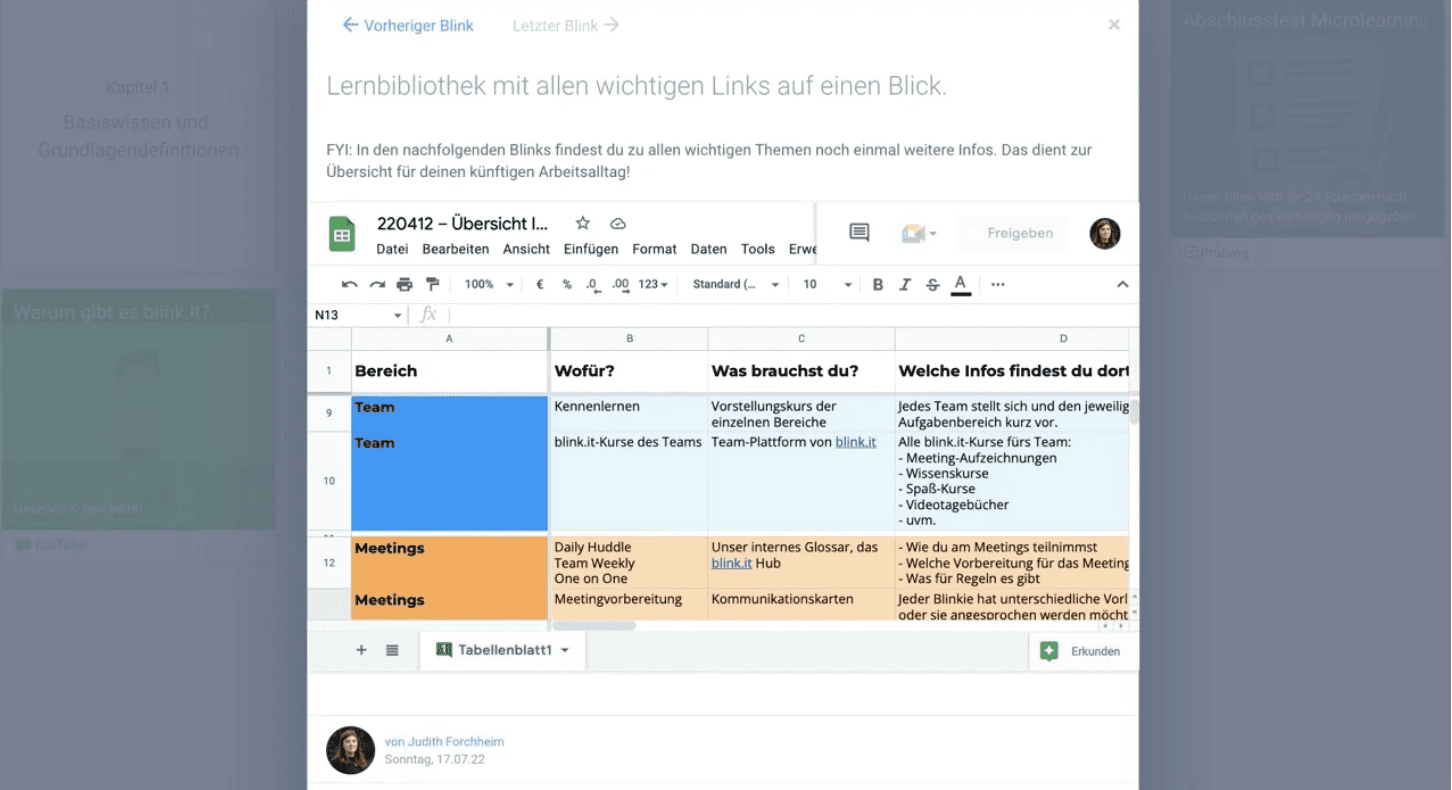
My personalized learning library with all relevant info. // Source: blink.it
3. Regular feedback and time for reviews
Regular and constructive feedback is crucial for learning success. That's why blink.it pays special attention to sufficient feedback during onboarding. I received this, for example, in the form of reviews (for blog articles) or in the form of quizzes via the blink.it platform. In addition, a time block was scheduled at the end of each working day for unresolved questions.
Furthermore, one of my tasks was to keep a video diary at the end of each working day. My colleague Corinna recently published an article on this topic: Methods in Onboarding – The Video Diary
In my video diary, I reflected on the day in a 2-minute video based on the following questions:
What did I learn today?
What did I like most today?
What else would I have wished for?
This feedback is not only useful for yourself, but also allows colleagues to participate in my onboarding who otherwise don't work with me very much.
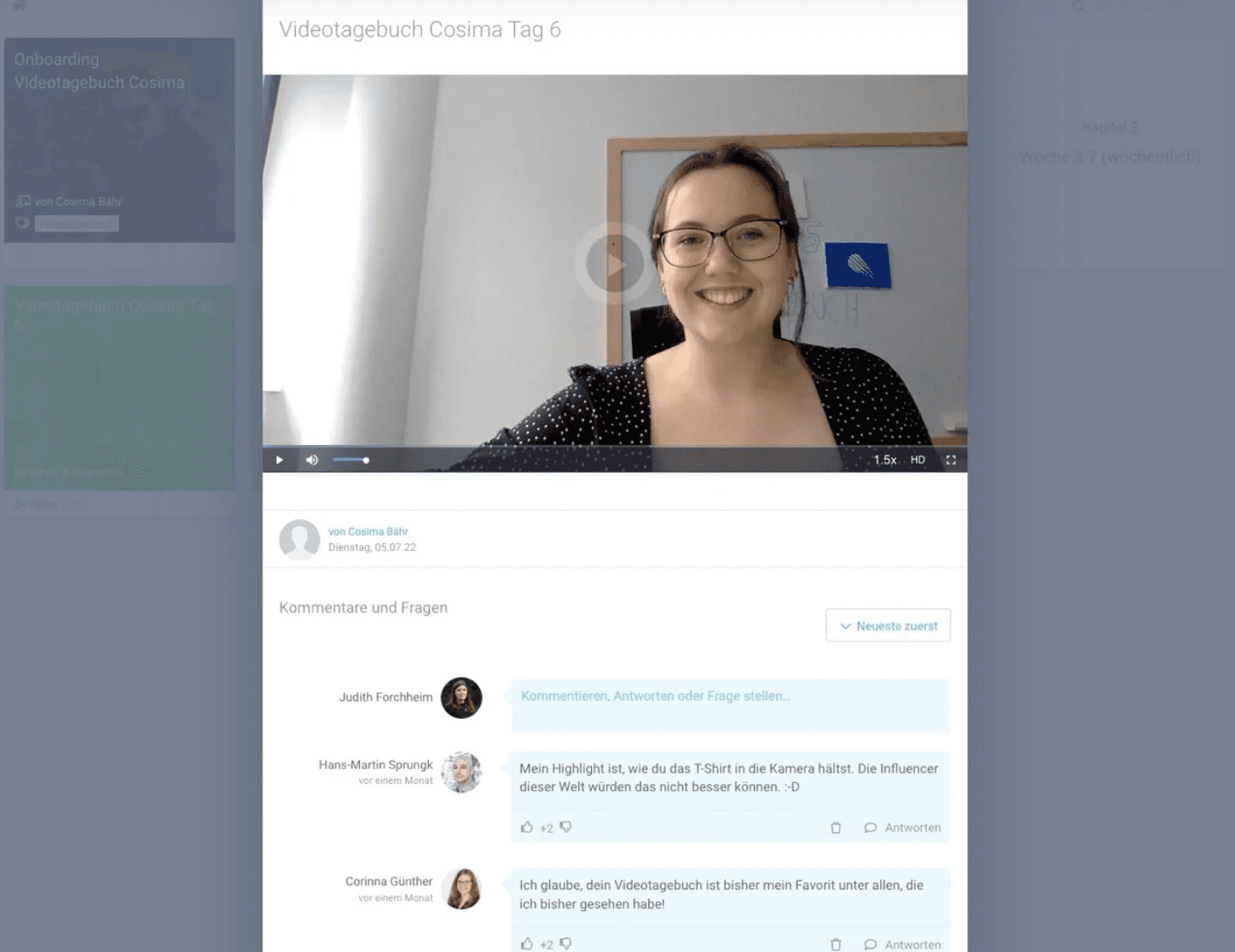
My video diary on the blink.it platform. // Source: blink.it
4. Participation in team events and meetings from the start
Joint events strengthen cohesion within the team and promote a relaxed working atmosphere. I was able to experience this for myself even before my first day of work at blink.it. Even before my first day in the office, I took part in the annual summer camp and went on a trip with the entire team. But even having lunch together strengthens team building, as we eat together in the office as a team and thus also exchange ideas away from work content. To stay up to date on what colleagues are currently working on, our daily lunch meeting (Daily Huddle) takes place. Here, not only the focus for the respective day is discussed, but also problems or things worth sharing.
Conclusion: My personalized onboarding
Personalized onboarding combines structured training with individual learning content, personal guidance, and regular feedback.
My own onboarding at blink.it shows that personalization does not mean reinventing the entire process for every new employee. Rather, the decisive factor is to adapt content and measures specifically to the area of responsibility, prior knowledge, and personal needs.
A dedicated contact person, a suitable learning library, regular feedback, and early integration into the team helped me to work independently quickly. Digital learning offers complemented the personal exchange and made important information available at all times.

Frequently Asked Questions and Answers
What does personalized onboarding mean?
Personalized onboarding adapts training to the area of responsibility, prior knowledge, and individual needs of a new employee. In doing so, standardized measures can be combined with personal and role-specific content.
What advantages does personalized onboarding offer?
New employees receive specifically the information and support they need for their tasks. This allows them to find their way around more quickly, work increasingly independently, and take on responsibility early on.
Which measures are suitable for personalized onboarding?
Suitable measures include, for example, a dedicated contact person, role-specific learning content, personalized learning libraries, regular feedback meetings, video diaries, as well as joint meetings and team events.
How can digital learning offers support personalized onboarding?
Digital learning offers make relevant information, courses, and support available at all times. Content can be put together to suit the area of responsibility, while personal contact persons remain available for feedback and individual questions.