“Videos are a must-have in corporate training and development” - according to the findings of numerous studies. But what are actually the benefits of video learning in companies? This article provides a quick overview and 6 strong arguments for HR managers who want to get started with videos in e-learning.
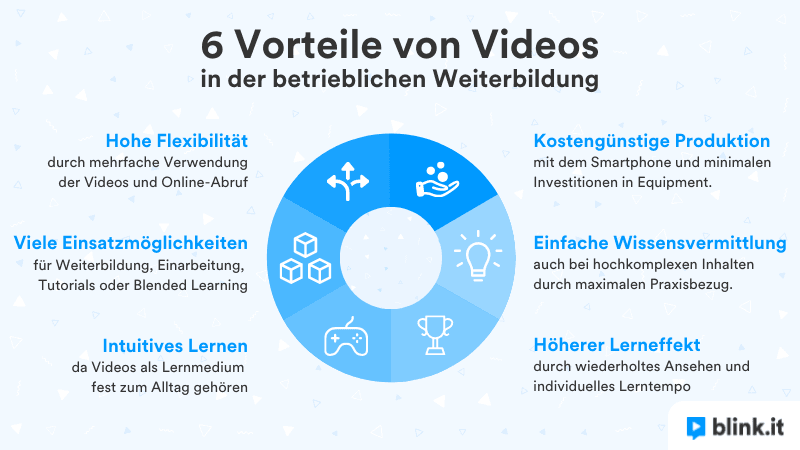
Overview: The 6 benefits of videos at a glance
Benefit 1: Make complex content easy to understand
Why do nearly 90% of all students learn using YouTube videos? Because content in videos is explained in a clear and memorable way. Videos allow for a high level of practical relevance. Just think of tutorials on how to use complex programs or machinery (who actually likes reading thick manuals and manages to make sense of them anyway?). Or situations directly from everyday work life that can be depicted in a video, such as interview scenarios.
Instructional videos have a key advantage over classic manuals and graphics: A video allows employees to go through even complex processes step-by-step "live" and imitate them immediately. And in significantly less time than written or illustrated instructions: Ideally, learning videos are a maximum of 3 minutes long (see also Benefit 4: Time savings).
More on this: 5 ideas for successful learning videos in companies
#2 Video production is cost-effective
Creating, printing, updating, and reprinting training manuals or handouts: All of this costs companies a lot of time and, above all, money. The production of instructional videos, on the other hand, is quick and easy:
In the simplest version, companies can create learning videos using nothing more than smartphones. Most modern smartphones offer very high camera quality, even without additional equipment. With a small investment in useful video tools, companies can set up their own video studio cost-effectively.
#3 Better learning effect through repetition
In traditional courses and training, content is explained once, maybe twice. If employees haven't understood the content by then, the long-term learning effect is questionable.
With instructional videos, however, employees have complete control over their learning process: pause the video, rewind, watch difficult passages again. Taking notes is also easier with a "pause button." All of this contributes to a higher and more sustainable learning effect.
#4 Time savings through high flexibility
Traditional training and education courses have to be reorganized for each learning group. Above all, this involves a high time commitment for everyone involved: the time required for organization is just as significant as the absence (and eventual travel time) of the employees.
Videos, on the other hand, preserve knowledge at a quality standard. Once created, instructional videos can be used over and over again. As part of e-learning, the place of learning is also flexible: employees can watch the videos directly at their workspace. In this way, learning videos in companies offer full flexibility in terms of time and location.
Speaking of time: How long should a good learning video be?
#5 Videos have many possible applications
Not all videos are the same. And instructional videos are not only suitable for training in the traditional sense. There are different types of learning videos, and correspondingly many areas of application in companies. For example:
Digital onboarding with instructional videos, ideal for new employees working from home
Preparation and follow-up for in-person training in a blended learning style
Video tutorials for important everyday processes
Screencasts for step-by-step explanations of workflows or software
#6 Intuitive learning and high acceptance through habit
Video platforms like YouTube have long been part of everyday (learning) life, and not just for students. In 2021, the average use of videos on the internet in Germany was 64 minutes. In contrast, text is consumed for only 20 minutes a day. The success of TikTok also shows that short videos are very well received. A clear indicator: for most employees, videos are part of their private daily lives.
Companies can take advantage of this preference and habit: with instructional videos, employees have a familiar format for training that most can interact with intuitively. This facilitates access to training content and increases motivation to learn.
Reading tip: To ensure that learning videos are really well received, you should avoid these 7 mistakes when creating learning videos!
Overall, videos offer great opportunities for corporate training and development - both for employees and for HR development and trainers. The only remaining drawback is the production effort, which can be greatly minimized today thanks to good smartphone cameras. Therefore, a low-effort pilot project is always worthwhile to test the acceptance and added value of learning videos in your own company.